Search any question & find its solution
Question:
Answered & Verified by Expert
A block of mass $5 \mathrm{~kg}$ starts up a $45^{\circ}$ incline plane with initial kinetic energy of $100 \mathrm{~J}$. If the coefficient of friction between block and plane is 0.5 then the distance covered by the block before it stops is
(Acceleration due to gravity $=10 \mathrm{~ms}^{-2}$ )
Options:
(Acceleration due to gravity $=10 \mathrm{~ms}^{-2}$ )
Solution:
2330 Upvotes
Verified Answer
The correct answer is:
$\frac{4 \sqrt{2}}{3} m$
Block stops on incline plane when its initial K.E is used in doing work against friction and partly it is converted into potential energy.
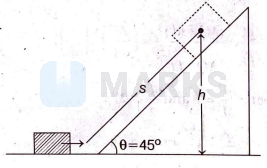
As angle of incline is given $45^{\circ}$ so, distance covered on incline $(s)$ is retaled to height of block (h) as,
$\Rightarrow \quad \sin 45^{\circ}=\frac{h}{s}$
or $s=\sqrt{2} . h$
Let block covers a distance $s$ over block and reaches upto height $h$. Then
Initial K.E of block = Work done against friction + Potential energy gained by block
$\begin{aligned} & \Rightarrow \frac{1}{2} m u^2=\mu m g \cos \theta \cdot s+m g h \\ & \Rightarrow \frac{1}{2} m u^2=\mu m g \cos \theta \cdot \sqrt{2} \cdot h+m g h\end{aligned}$
$\Rightarrow \quad h=\frac{\frac{1}{2} m u^2}{\sqrt{2} \mu m g \cos \theta+m g}$
Here, initial K. $\mathrm{E}=\frac{1}{2} m u^2=100 \mathrm{~J}$
$m=5 \mathrm{~kg}, \theta=45^{\circ}, g=10 \mathrm{~m} / \mathrm{s}^2$
So,
$h=\frac{100}{\sqrt{2} \times 0.5 \times 5 \times 10 \times \frac{1}{\sqrt{2}}+5 \times 10}$
$=\frac{100}{50 \times 1.5}=\frac{4}{3}$
Hence, distance covered over block, $s=\sqrt{2} h$
$\Rightarrow \quad s=\frac{\sqrt{2} \times 4}{3} \mathrm{~m}=\frac{4 \sqrt{2}}{3} \mathrm{~m}$
As angle of incline is given $45^{\circ}$ so, distance covered on incline $(s)$ is retaled to height of block (h) as,
$\Rightarrow \quad \sin 45^{\circ}=\frac{h}{s}$
or $s=\sqrt{2} . h$
Let block covers a distance $s$ over block and reaches upto height $h$. Then
Initial K.E of block = Work done against friction + Potential energy gained by block
$\begin{aligned} & \Rightarrow \frac{1}{2} m u^2=\mu m g \cos \theta \cdot s+m g h \\ & \Rightarrow \frac{1}{2} m u^2=\mu m g \cos \theta \cdot \sqrt{2} \cdot h+m g h\end{aligned}$
$\Rightarrow \quad h=\frac{\frac{1}{2} m u^2}{\sqrt{2} \mu m g \cos \theta+m g}$
Here, initial K. $\mathrm{E}=\frac{1}{2} m u^2=100 \mathrm{~J}$
$m=5 \mathrm{~kg}, \theta=45^{\circ}, g=10 \mathrm{~m} / \mathrm{s}^2$
So,
$h=\frac{100}{\sqrt{2} \times 0.5 \times 5 \times 10 \times \frac{1}{\sqrt{2}}+5 \times 10}$
$=\frac{100}{50 \times 1.5}=\frac{4}{3}$
Hence, distance covered over block, $s=\sqrt{2} h$
$\Rightarrow \quad s=\frac{\sqrt{2} \times 4}{3} \mathrm{~m}=\frac{4 \sqrt{2}}{3} \mathrm{~m}$
Looking for more such questions to practice?
Download the MARKS App - The ultimate prep app for IIT JEE & NEET with chapter-wise PYQs, revision notes, formula sheets, custom tests & much more.