Search any question & find its solution
Question:
Answered & Verified by Expert
A factory manufactures two types of screws, A and B, Each type of screw requires the use of two machines, an automatic and a hand operated. It takes 4 minutes on the automatic and 6 minutes on hand operated machines to manufacture a package of screws $A$, while it takes 6 minutes on automatic and 3 minutes on the hand operated machines to manufacture a package of screws B. Each machine is available for at the most 4 hours on any day. The manufacturer can sell a package of screws $A$ at a profit of $₹ 7$ and screws $B$ at a profit of $₹ 10$. Assuming that he can sell all the screws he manufactures, how many packages of each type should the factory owner produce in a day in order to maximise his profit? Determine the maximum profit.
Solution:
1412 Upvotes
Verified Answer
Let the manufacturer produces $x$ packages of screws A and $y$ packages of screw $B$, then time taken by $x$ packages of screw A and y packages of screw B on automatic machine $=(4 x+6 y)$ minutes. And hand operated machine $=(6 \mathrm{x}+3 \mathrm{y})$ minutes
As each machine is available for at the most 4 hours i.e., $4 \times 60=240$ minutes.So,
we have $4 \mathrm{x}+6 \mathrm{y} \leq 240$ i.e., $2 \mathrm{x}+3 \mathrm{y} \leq 120$ and $6 \mathrm{x}+3 \mathrm{y} \leq 240$ i.e., $2 \mathrm{x}+\mathrm{y} \leq 80$
Profit on selling x packages of screws A and y packages of screws $B$ is $Z=7 x+10 y$.
So, to find $x$ and $y$ such that $Z=7 x+10 y$ is maximum subject to $2 x+3 y \leq 120,2 x+y \leq 80$, $x \geq 0$ and $y \geq 0$. The feasible portion of the graph satisfying the inequalities $2 x+3 y \leq 120$ and $2 x+y \leq 80$ is $\mathrm{OABC}$ which is shaded in the figure. Coordinates of O, $\mathrm{A}, \mathrm{B}$ and $\mathrm{C}$ are $(0,0)$, $(0,40),(30,20)$ and $(40,0)$ respectively.
At A $(0,40), \quad \mathrm{Z}=7 \mathrm{x}+10 \mathrm{y}=0+10 \times 40=400$
At B $(30,20), \quad Z=7 \times 30+10 \times 20=410 \max ^{\mathrm{m}}$
At C $(40,0), \quad \mathrm{Z}=7 \times 40+0=280$
At $\mathrm{O, }(0,0), \quad \mathrm{Z}=0$
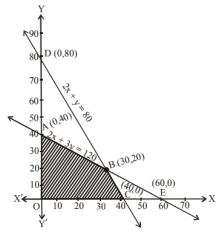
Hence, the maximum profit $₹ 410$ when 30 screws of type $A$ and 20 screws of type B are produced.
As each machine is available for at the most 4 hours i.e., $4 \times 60=240$ minutes.So,
we have $4 \mathrm{x}+6 \mathrm{y} \leq 240$ i.e., $2 \mathrm{x}+3 \mathrm{y} \leq 120$ and $6 \mathrm{x}+3 \mathrm{y} \leq 240$ i.e., $2 \mathrm{x}+\mathrm{y} \leq 80$
Profit on selling x packages of screws A and y packages of screws $B$ is $Z=7 x+10 y$.
So, to find $x$ and $y$ such that $Z=7 x+10 y$ is maximum subject to $2 x+3 y \leq 120,2 x+y \leq 80$, $x \geq 0$ and $y \geq 0$. The feasible portion of the graph satisfying the inequalities $2 x+3 y \leq 120$ and $2 x+y \leq 80$ is $\mathrm{OABC}$ which is shaded in the figure. Coordinates of O, $\mathrm{A}, \mathrm{B}$ and $\mathrm{C}$ are $(0,0)$, $(0,40),(30,20)$ and $(40,0)$ respectively.
At A $(0,40), \quad \mathrm{Z}=7 \mathrm{x}+10 \mathrm{y}=0+10 \times 40=400$
At B $(30,20), \quad Z=7 \times 30+10 \times 20=410 \max ^{\mathrm{m}}$
At C $(40,0), \quad \mathrm{Z}=7 \times 40+0=280$
At $\mathrm{O, }(0,0), \quad \mathrm{Z}=0$
Hence, the maximum profit $₹ 410$ when 30 screws of type $A$ and 20 screws of type B are produced.
Looking for more such questions to practice?
Download the MARKS App - The ultimate prep app for IIT JEE & NEET with chapter-wise PYQs, revision notes, formula sheets, custom tests & much more.