Search any question & find its solution
Question:
Answered & Verified by Expert
(a) Given $\mathbf{n}$ resistors each of resistance $\mathrm{R}$, how will you combine them to get the (i) maximum (ii) minimum effective resistance? What is the ratio of the maximum to minimum resistance?
(b) Given the resistances of $1 \Omega, 2 \Omega, 3 \Omega$, how will be combine them to get an equivalent resistance of (i) $(11 / 3) \Omega$ (ii) $(11 / 5) \Omega$, (iii) $6 \Omega$ (iv) $(6 / 11) \Omega$ ?
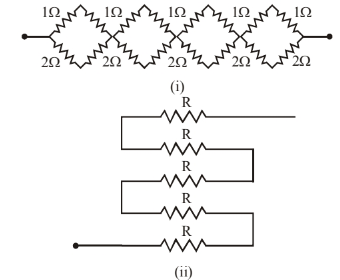
(c) Determine the equivalent resistance of networks shown in Fig (i) and (ii).
(b) Given the resistances of $1 \Omega, 2 \Omega, 3 \Omega$, how will be combine them to get an equivalent resistance of (i) $(11 / 3) \Omega$ (ii) $(11 / 5) \Omega$, (iii) $6 \Omega$ (iv) $(6 / 11) \Omega$ ?
(c) Determine the equivalent resistance of networks shown in Fig (i) and (ii).
Solution:
1292 Upvotes
Verified Answer
(a) For maximum effective resistance, resistors must be combined in series.
Maximum effective resistance $=\mathrm{nR}$
For minimum effective resistance, resistors must be combined in parallel.
Minimum effective resistance $=\frac{\mathrm{R}}{\mathrm{n}}$
Ratio, $\frac{\text { maximum }}{\text { minimum }}$ of effective resistance $=\frac{\mathrm{nR}}{\frac{\mathrm{R}}{\mathrm{n}}}=\mathrm{n}^2$.
(b) (i) $1 \Omega$ and $2 \Omega$ in parallel with $3 \Omega$ in their series. Equivalents resistance $=\frac{1 \times 2}{1+2}+3=\frac{2}{3}+3=\frac{11}{3} \Omega$.
(ii) $2 \Omega$ and $3 \Omega$ in parallel with $1 \Omega$ in their series.
Equivalents resistance $=\frac{2 \times 3}{2+3}+1=\frac{6}{5}+1=\frac{11}{5} \Omega$
(iii) All in series, equivalent resistance $=1+2+3=6 \Omega$.
(iv) All resistance in parallel,
$$
\frac{1}{\text { Eq.resistance }}=\frac{1}{1}+\frac{1}{2}+\frac{1}{3}+=\frac{11}{6}
$$
or equivalent resistance $=\frac{6}{11} \Omega$.
(c) (i) It is equivalent to four $2 \Omega-4 \Omega$ parallel combination in series.
Each combination $=\frac{2 \times 4}{2+4}=\frac{8}{6}=\frac{4}{3} \Omega$
Since such four combination are in series.
$\therefore$ Total resistance $=4 \times \frac{4}{3}=\frac{16}{3} \Omega$.
(ii) It is equivalent to 5 resistors, each of resistance $R$ in series. Total resistance $=5 \mathrm{R}$.
Maximum effective resistance $=\mathrm{nR}$
For minimum effective resistance, resistors must be combined in parallel.
Minimum effective resistance $=\frac{\mathrm{R}}{\mathrm{n}}$
Ratio, $\frac{\text { maximum }}{\text { minimum }}$ of effective resistance $=\frac{\mathrm{nR}}{\frac{\mathrm{R}}{\mathrm{n}}}=\mathrm{n}^2$.
(b) (i) $1 \Omega$ and $2 \Omega$ in parallel with $3 \Omega$ in their series. Equivalents resistance $=\frac{1 \times 2}{1+2}+3=\frac{2}{3}+3=\frac{11}{3} \Omega$.
(ii) $2 \Omega$ and $3 \Omega$ in parallel with $1 \Omega$ in their series.
Equivalents resistance $=\frac{2 \times 3}{2+3}+1=\frac{6}{5}+1=\frac{11}{5} \Omega$
(iii) All in series, equivalent resistance $=1+2+3=6 \Omega$.
(iv) All resistance in parallel,
$$
\frac{1}{\text { Eq.resistance }}=\frac{1}{1}+\frac{1}{2}+\frac{1}{3}+=\frac{11}{6}
$$
or equivalent resistance $=\frac{6}{11} \Omega$.
(c) (i) It is equivalent to four $2 \Omega-4 \Omega$ parallel combination in series.
Each combination $=\frac{2 \times 4}{2+4}=\frac{8}{6}=\frac{4}{3} \Omega$
Since such four combination are in series.
$\therefore$ Total resistance $=4 \times \frac{4}{3}=\frac{16}{3} \Omega$.
(ii) It is equivalent to 5 resistors, each of resistance $R$ in series. Total resistance $=5 \mathrm{R}$.
Looking for more such questions to practice?
Download the MARKS App - The ultimate prep app for IIT JEE & NEET with chapter-wise PYQs, revision notes, formula sheets, custom tests & much more.