Search any question & find its solution
Question:
Answered & Verified by Expert
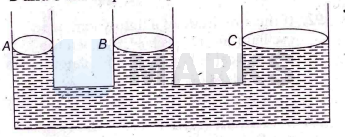
A hydraulic lift is shown in the figure. The movable pistons $A, B$ and $C$ are of radius $10 \mathrm{~cm}, 100 \mathrm{~m}$ and $5 \mathrm{~cm}$ respectively. If a body. of mass $2 \mathrm{~kg}$ is placed on piston $A$, the maximum masses that can be lifted by piston $B$ and $C$ are respectively.
Options:
Solution:
1865 Upvotes
Verified Answer
The correct answer is:
None of the above
Given, $r_A=10 \mathrm{~cm}=0.1 \mathrm{~m}$
$\begin{aligned} & r_B=100 \mathrm{~m} \\ & r_C=5 \mathrm{~cm}=0.05 \mathrm{~m}\end{aligned}$
weight placed on piston $A=m \times g$
$=2 \mathrm{~g}$
Using Pascal's law;
$\frac{F_A}{A_A}=\frac{F_B}{A_B}=\frac{F_C}{A_C}$
$\Rightarrow \quad \frac{2 g}{\pi(0.1)^2}=\frac{F_B}{\pi(100)^2}=\frac{F_C}{\pi(0.05)^2}$ ...(i)
From Eq. (i) we have
$F_B=\frac{2 g}{\pi(0.1)^2} \times \frac{\pi(100)^2}{1}=\frac{2 \times 10000 \times g}{0.01}$
$=2 \times 10^6 \mathrm{~g}$
Similarly, $F_C=\frac{\pi(0.05)^2}{1} \times \frac{2 g}{\pi(0.1)^2}$
$=\frac{0.0025}{0.01} \times 2 \mathrm{~g}=0.50 \mathrm{~g}$
Hence, $B$ can lift mass of $2 \times 10^6 \mathrm{~kg}$ and $C$ can lift mass of $0.50 \mathrm{~kg}$.
Therefore, no option is correct.
$\begin{aligned} & r_B=100 \mathrm{~m} \\ & r_C=5 \mathrm{~cm}=0.05 \mathrm{~m}\end{aligned}$
weight placed on piston $A=m \times g$
$=2 \mathrm{~g}$
Using Pascal's law;
$\frac{F_A}{A_A}=\frac{F_B}{A_B}=\frac{F_C}{A_C}$
$\Rightarrow \quad \frac{2 g}{\pi(0.1)^2}=\frac{F_B}{\pi(100)^2}=\frac{F_C}{\pi(0.05)^2}$ ...(i)
From Eq. (i) we have
$F_B=\frac{2 g}{\pi(0.1)^2} \times \frac{\pi(100)^2}{1}=\frac{2 \times 10000 \times g}{0.01}$
$=2 \times 10^6 \mathrm{~g}$
Similarly, $F_C=\frac{\pi(0.05)^2}{1} \times \frac{2 g}{\pi(0.1)^2}$
$=\frac{0.0025}{0.01} \times 2 \mathrm{~g}=0.50 \mathrm{~g}$
Hence, $B$ can lift mass of $2 \times 10^6 \mathrm{~kg}$ and $C$ can lift mass of $0.50 \mathrm{~kg}$.
Therefore, no option is correct.
Looking for more such questions to practice?
Download the MARKS App - The ultimate prep app for IIT JEE & NEET with chapter-wise PYQs, revision notes, formula sheets, custom tests & much more.