Search any question & find its solution
Question:
Answered & Verified by Expert
A particle of mass $1 \times 10^{-27} \mathrm{~kg}$ and charge $1 \times 10^{-16} \mathrm{C}$ enters the uniform magnetic field within the solenoid, at speed $1000 \mathrm{~ms}^{-1}$. The velocity vector makcs an angle $60^{\circ}$ with the axis of solenoid. The solenoid has 5000 turns along its length and carries current $5 \mathrm{~A}$. The number of revolution the particle makes along the helical path within the solenoid by the time it emerges from solenoid's opposite end is
Options:
Solution:
2840 Upvotes
Verified Answer
The correct answer is:
$1 \times 10^6$
The given situation is shown below.
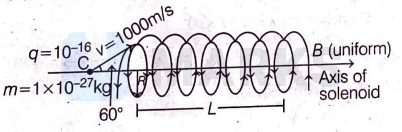
Given, $\begin{aligned} v & =1000 \mathrm{~m} / \mathrm{s} \\ q & =10^{-16} \mathrm{C} \\ m & =1 \times 10^{-27} \mathrm{~kg}\end{aligned}$
$$
\begin{aligned}
N & =\text { Number of turns }=5000 \\
I & =5 \mathrm{~A} \\
R & =\text { Radius of circular path of charge }
\end{aligned}
$$
$R=$ Radius of circular path of charge
Magnetic field, $B=\mu_0 n l$ (where, $n=$ number of turns per unit length)
$$
\begin{aligned}
& \Rightarrow B=\mu_0 \frac{N}{L} I (where, n=\frac{N}{L} )\\
& \Rightarrow B=\mu_0 \times \frac{5000}{L} \times 5 \\
& \Rightarrow B=\mu_0 \times \frac{25000}{L}...(i)
\end{aligned}
$$
Also we know that, Distance $=$ speed $\times$ time $L=v_x \times t$ (where, $v_x$ is the component of velocity along the axis of the solenoid)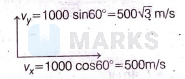
$$
\Rightarrow
$$
$$
L=500 t...(ii)
$$
Also, radius of circular path of a charged particle in uniform magnetic field is given by the formula
$$
\begin{aligned}
R & =\frac{m v_j}{9 B} \quad \text { (where, } v_y=500 \sqrt{3} \text { ) } \\
\text { Putting, } B & =\frac{\mu_0 \times 25000}{L} \quad \text { [from Eq .(i)] } \\
R & =\frac{10^{-11} \times 500 \sqrt{3} \times L}{10^{-16} \times \mu_0 \times 25000} \\
\Rightarrow \quad R & =\frac{10^{-11} \times \sqrt{3} L}{50 \mu_0} \quad \text {...(ii) }
\end{aligned}
$$
Now, time taken by the charged particle to exit the solenoid moving along the circular path making $N^{\prime}$ number of revolutions.
$$
\begin{aligned}
t^{\prime} & =\frac{\text { circular distance }}{v_y} \Rightarrow t^{\prime}=\frac{2 \pi R \times \text { no. of revolutions }}{v_y} \\
t^{\prime} & =\frac{2 \pi R \times N^{\prime}}{v_y} \\
t^{\prime} & =\frac{2 \pi \times 10^{-11} \times \sqrt{3} L \times N^{\prime}}{50 \mu_0 \times 500 \sqrt{3}}
...(iii)\end{aligned}
$$
Now, since time taken to cover linear distance and circular distance before exiting the solenoid are same
$$
t=t^{\prime}
$$
So, from Eqs. (i) and (ii)
$$
\frac{L}{500}=\frac{2 \pi \times 10^{-11} \times \sqrt{3} \times L \times N^{\prime}}{50 \times 4 \pi \times 10^{-7} \times 500 \sqrt{3}} \quad\left(\because \mu_0=4 \pi \times 10^{-7}\right)
$$
On solving, we get
$$
N^{\prime}=\frac{100 \times 10^{-7}}{10^{-11}}=\frac{10^{-5}}{10^{-11}}=10^6
$$
Hence, total number of revolution along helical path by the time it emerges the solenoid $=1 \times 10^6$. Hence, option (b) is the correct answer.
Given, $\begin{aligned} v & =1000 \mathrm{~m} / \mathrm{s} \\ q & =10^{-16} \mathrm{C} \\ m & =1 \times 10^{-27} \mathrm{~kg}\end{aligned}$
$$
\begin{aligned}
N & =\text { Number of turns }=5000 \\
I & =5 \mathrm{~A} \\
R & =\text { Radius of circular path of charge }
\end{aligned}
$$
$R=$ Radius of circular path of charge
Magnetic field, $B=\mu_0 n l$ (where, $n=$ number of turns per unit length)
$$
\begin{aligned}
& \Rightarrow B=\mu_0 \frac{N}{L} I (where, n=\frac{N}{L} )\\
& \Rightarrow B=\mu_0 \times \frac{5000}{L} \times 5 \\
& \Rightarrow B=\mu_0 \times \frac{25000}{L}...(i)
\end{aligned}
$$
Also we know that, Distance $=$ speed $\times$ time $L=v_x \times t$ (where, $v_x$ is the component of velocity along the axis of the solenoid)
$$
\Rightarrow
$$
$$
L=500 t...(ii)
$$
Also, radius of circular path of a charged particle in uniform magnetic field is given by the formula
$$
\begin{aligned}
R & =\frac{m v_j}{9 B} \quad \text { (where, } v_y=500 \sqrt{3} \text { ) } \\
\text { Putting, } B & =\frac{\mu_0 \times 25000}{L} \quad \text { [from Eq .(i)] } \\
R & =\frac{10^{-11} \times 500 \sqrt{3} \times L}{10^{-16} \times \mu_0 \times 25000} \\
\Rightarrow \quad R & =\frac{10^{-11} \times \sqrt{3} L}{50 \mu_0} \quad \text {...(ii) }
\end{aligned}
$$
Now, time taken by the charged particle to exit the solenoid moving along the circular path making $N^{\prime}$ number of revolutions.
$$
\begin{aligned}
t^{\prime} & =\frac{\text { circular distance }}{v_y} \Rightarrow t^{\prime}=\frac{2 \pi R \times \text { no. of revolutions }}{v_y} \\
t^{\prime} & =\frac{2 \pi R \times N^{\prime}}{v_y} \\
t^{\prime} & =\frac{2 \pi \times 10^{-11} \times \sqrt{3} L \times N^{\prime}}{50 \mu_0 \times 500 \sqrt{3}}
...(iii)\end{aligned}
$$
Now, since time taken to cover linear distance and circular distance before exiting the solenoid are same
$$
t=t^{\prime}
$$
So, from Eqs. (i) and (ii)
$$
\frac{L}{500}=\frac{2 \pi \times 10^{-11} \times \sqrt{3} \times L \times N^{\prime}}{50 \times 4 \pi \times 10^{-7} \times 500 \sqrt{3}} \quad\left(\because \mu_0=4 \pi \times 10^{-7}\right)
$$
On solving, we get
$$
N^{\prime}=\frac{100 \times 10^{-7}}{10^{-11}}=\frac{10^{-5}}{10^{-11}}=10^6
$$
Hence, total number of revolution along helical path by the time it emerges the solenoid $=1 \times 10^6$. Hence, option (b) is the correct answer.
Looking for more such questions to practice?
Download the MARKS App - The ultimate prep app for IIT JEE & NEET with chapter-wise PYQs, revision notes, formula sheets, custom tests & much more.