Search any question & find its solution
Question:
Answered & Verified by Expert
A particle of mass $10 \mathrm{~g}$ moves along a circle of radius $6.4 \mathrm{~cm}$ with a constant tangential acceleration. If the kinetic energy of the particle becomes $8 \times 10^{-4} \mathrm{~J}$ by the end of the second revolution after the beginning of the motion, the magnitude of the tangential acceleration is
Options:
Solution:
1215 Upvotes
Verified Answer
The correct answer is:
0.1 m/s
Consider the following diagram:
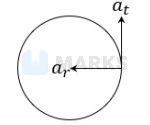
The tangential acceleration is given by,
$\begin{aligned}
& a_t=\frac{\mathrm{d} v}{\mathrm{~d} t}=\text { Constant } \\
& \Rightarrow \frac{\mathrm{d} v}{\mathrm{~d} t}=a_t \\
& \Rightarrow \frac{\mathrm{d} s}{\mathrm{~d} t} \cdot \frac{\mathrm{d} v}{\mathrm{~d} s}=a t \\
& \Rightarrow v=\frac{\mathrm{d} v}{\mathrm{~d} t}=a_t \\
& \Rightarrow \int_0^v \frac{v^2}{2} \mathrm{~d} v=\int_0^{(4 \pi r)} a_t \mathrm{~d} s
\end{aligned}$
We know,
Now, kinetic energy is given by,
$K E=\frac{m v^2}{2}$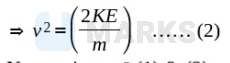
Now, using eq ${ }^{\mathrm{n}}(1) \&(2)$
$\begin{aligned}
& \left(\frac{2 K E}{m}\right)=(8 \pi r) a_t \\
& \Rightarrow a_t=\left(\frac{K E}{(4 \pi r) m}\right)
\end{aligned}$
Given, $K E=8 \times 10^{-4} \mathrm{~J}, r=6.4 \times 10^{-2} \mathrm{~m}$ and $m=1 \times 10^{-2} \mathrm{~kg}$.
$\Rightarrow a_t=\frac{\left(8 \times 10^{-4}\right) \mathrm{J}}{4 \pi\left(6.4 \times 10^{-2} \mathrm{~m}\right)\left(10^{-2} \mathrm{~kg}\right)}=0.1 \mathrm{~m} / \mathrm{s}^2$
The tangential acceleration is given by,
$\begin{aligned}
& a_t=\frac{\mathrm{d} v}{\mathrm{~d} t}=\text { Constant } \\
& \Rightarrow \frac{\mathrm{d} v}{\mathrm{~d} t}=a_t \\
& \Rightarrow \frac{\mathrm{d} s}{\mathrm{~d} t} \cdot \frac{\mathrm{d} v}{\mathrm{~d} s}=a t \\
& \Rightarrow v=\frac{\mathrm{d} v}{\mathrm{~d} t}=a_t \\
& \Rightarrow \int_0^v \frac{v^2}{2} \mathrm{~d} v=\int_0^{(4 \pi r)} a_t \mathrm{~d} s
\end{aligned}$
We know,
Now, kinetic energy is given by,
$K E=\frac{m v^2}{2}$
Now, using eq ${ }^{\mathrm{n}}(1) \&(2)$
$\begin{aligned}
& \left(\frac{2 K E}{m}\right)=(8 \pi r) a_t \\
& \Rightarrow a_t=\left(\frac{K E}{(4 \pi r) m}\right)
\end{aligned}$
Given, $K E=8 \times 10^{-4} \mathrm{~J}, r=6.4 \times 10^{-2} \mathrm{~m}$ and $m=1 \times 10^{-2} \mathrm{~kg}$.
$\Rightarrow a_t=\frac{\left(8 \times 10^{-4}\right) \mathrm{J}}{4 \pi\left(6.4 \times 10^{-2} \mathrm{~m}\right)\left(10^{-2} \mathrm{~kg}\right)}=0.1 \mathrm{~m} / \mathrm{s}^2$
Looking for more such questions to practice?
Download the MARKS App - The ultimate prep app for IIT JEE & NEET with chapter-wise PYQs, revision notes, formula sheets, custom tests & much more.