Search any question & find its solution
Question:
Answered & Verified by Expert
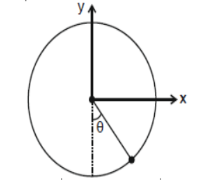
A particle of mass ' $m$ ' having speed $v$ goes in a vertical circular motion such that its centre is at its origin, as shown in the figure. If at any instant the angle made by the string with a negative $y$-axis is $\theta$ then the tension in the string is:
[Take radius $=\mathrm{R}$ ]
Options:
[Take radius $=\mathrm{R}$ ]
Solution:
2902 Upvotes
Verified Answer
The correct answer is:
$m g \cos \theta+\frac{m v^2}{R}$
To find the tension in the string, we need to analyze the forces acting on the particle in the vertical circular motion.
Given:
- Mass of the particle $=m$
- Speed of the particle $=v$
- Radius of the circular path $=R$
- Angle made by the string with the negative $y$-axis $=\theta$
We need to consider two forces acting on the particle:
1. The gravitational force $(m g)$ acting downwards.
2. The tension in the string $(T)$.
At any angle $\theta$, the forces in the radial direction need to provide the centripetal force for the circular motion. The components of the forces in the radial direction are:
- The component of the gravitational force along the radius: $m g \cos \theta$
- The tension in the string: $T$
The net force providing the centripetal acceleration is:
$T-m g \cos \theta=\frac{m v^2}{R}$
Solving for $T$ :
$T=\frac{m v^2}{R}+m g \cos \theta$
Thus, the correct answer is:
$m g \cos \theta+\frac{m v^2}{R}$
Which corresponds to option 3 in the given choices.
Given:
- Mass of the particle $=m$
- Speed of the particle $=v$
- Radius of the circular path $=R$
- Angle made by the string with the negative $y$-axis $=\theta$
We need to consider two forces acting on the particle:
1. The gravitational force $(m g)$ acting downwards.
2. The tension in the string $(T)$.
At any angle $\theta$, the forces in the radial direction need to provide the centripetal force for the circular motion. The components of the forces in the radial direction are:
- The component of the gravitational force along the radius: $m g \cos \theta$
- The tension in the string: $T$
The net force providing the centripetal acceleration is:
$T-m g \cos \theta=\frac{m v^2}{R}$
Solving for $T$ :
$T=\frac{m v^2}{R}+m g \cos \theta$
Thus, the correct answer is:
$m g \cos \theta+\frac{m v^2}{R}$
Which corresponds to option 3 in the given choices.
Looking for more such questions to practice?
Download the MARKS App - The ultimate prep app for IIT JEE & NEET with chapter-wise PYQs, revision notes, formula sheets, custom tests & much more.