Search any question & find its solution
Question:
Answered & Verified by Expert
A particle $P$ starts from the point $z_0=1+2 i$, where $i=\sqrt{-1}$. It moves first horizontally away from origin by 5 units and then vertically away from origin by 3 units to reach a point $z_1$. From $z_1$ the particle moves $\sqrt{2}$ units in the direction of the vector $\hat{\mathbf{i}}+\hat{\mathbf{j}}$ and then it moves through an angle $\frac{\pi}{2}$ in anti-clockwise direction on a circle with centre at origin, to reach a point $z_2$. The point $z_2$ is given by
Options:
Solution:
1470 Upvotes
Verified Answer
The correct answer is:
$-6+7 i$
$-6+7 i$
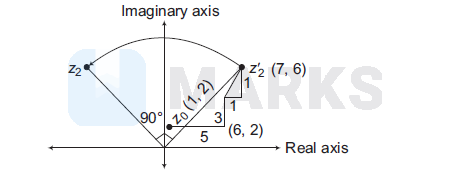
$$
z_2^{\prime}=\left(6+\sqrt{2} \times \cos 45^{\circ}, 5+\sqrt{2} \sin 45^{\circ}\right)=(7,6)=7+6 i
$$
By rotation about $(0,0)$,
$$
\begin{aligned}
& \frac{z_2}{z_2^{\prime}}=e^{i \frac{\pi}{2}} \\
& \Rightarrow \quad z_2=z_2^{\prime}\left(e^{i \frac{\pi}{2}}\right) \\
& \Rightarrow \quad z_2=(7+6 i)\left(\cos \frac{\pi}{-}+i \sin \frac{\pi}{-}\right)=(7+6 i)(i)=-6+7 i
\end{aligned}
$$
Looking for more such questions to practice?
Download the MARKS App - The ultimate prep app for IIT JEE & NEET with chapter-wise PYQs, revision notes, formula sheets, custom tests & much more.