Search any question & find its solution
Question:
Answered & Verified by Expert
A planet of mass $m$ moves in a elliptical orbit around an unknown star of mass $M$ such that its maximum and minimum distances from the star are equal to $r_1$ and $r_2$ respectively. The angular momentum of the planet relative to the centre of the star is
Options:
Solution:
1402 Upvotes
Verified Answer
The correct answer is:
$m \sqrt{\frac{2 G M r_1 r_2}{r_1+r_2}}$
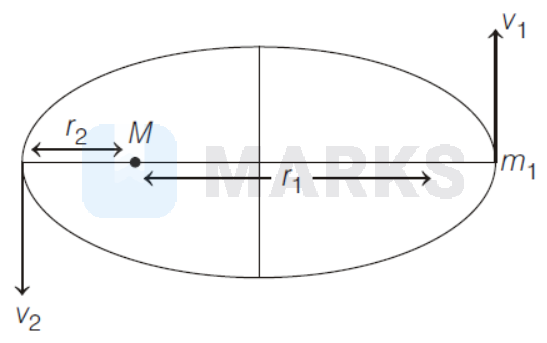
According to the law of conservation of angular momentum,
$$
\begin{aligned}
m v_1 r_1 & =m v_2 r_2 \\
\Rightarrow \quad v_2 & =\frac{v_1 r_1}{r_2}
\end{aligned}
$$
From the law of conservation of total mechanical energy.
$$
\frac{-G M m}{r_1}+\frac{1}{2} m v_1^2=-\frac{G M m}{r_2}+\frac{1}{2} m v_2^2
$$
From Eqs. (i) and (ii), we get
$$
v_1=\sqrt{\frac{2 G M r_2}{\left(r_1+r_2\right) r_1}}
$$
Angular momentum,
$$
\begin{aligned}
& L=m v_1 r_1=m\left(\sqrt{\frac{2 G M r_2}{\left(r_1+r_2\right) r_1}}\right) \times r_1 \\
& L=m \sqrt{\frac{2 G M r_1 r_2}{r_1+r_2}}
\end{aligned}
$$
Looking for more such questions to practice?
Download the MARKS App - The ultimate prep app for IIT JEE & NEET with chapter-wise PYQs, revision notes, formula sheets, custom tests & much more.