Search any question & find its solution
Question:
Answered & Verified by Expert
A solid cylinder of mass $2 \mathrm{~kg}$ and radius $50 \mathrm{~cm}$ rolls up an inclined plane of angle inclination $30^{\circ}$. The centre of mass of cylinder has speed of $4 \mathrm{~m} / \mathrm{s}$. The distance travelled by the cylinder on the inclined surface will be : (Take $g=10 \mathrm{~m} / \mathrm{s}^2$ )
Options:
Solution:
2872 Upvotes
Verified Answer
The correct answer is:
$2.4 \mathrm{~m}$
When a body rolls i.e. have rotational motion, the total kinetic energy of the system will be
$$
\mathrm{KE}=\frac{1}{2} \mathrm{mv}^2\left(1+\frac{\mathrm{k}^2}{\mathrm{R}^2}\right)
$$
where, $\mathrm{m}=$ mass of body, $\mathrm{v}=$ velocity and $\mathrm{k}=$ radius of gyration
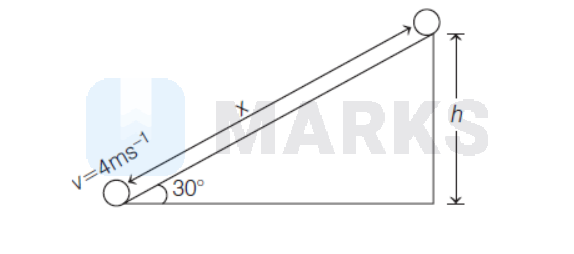
Given, $\mathrm{m}=2 \mathrm{~kg}, \theta=30^{\circ}, \mathrm{v}=4 \mathrm{~ms}^{-1}$
Let $h$ be the height of the inclined plane, then from law of conservation of energy,
$$
\begin{aligned}
\mathrm{KE} & =\mathrm{PE} \\
\frac{1}{2} \mathrm{mv}^2\left(1+\frac{\mathrm{k}^2}{\mathrm{R}^2}\right) & =\mathrm{mgh}
\end{aligned}
$$
Substituting the given values in the above equation, we get
$$
\begin{aligned}
& \frac{1}{2} \times 2 \times 16\left(1+\frac{1}{2}\right)=2 \times 10 \times \mathrm{h}\left[\because \text { For cylinder } \frac{\mathrm{k}^2}{\mathrm{R}^2}=\frac{1}{2}\right] \\
& \Rightarrow \quad 8 \times \frac{3}{2}=10 \mathrm{~h} \Rightarrow \mathrm{h}=1.2 \mathrm{~m}
\end{aligned}
$$
From the above diagram
$$
\begin{gathered}
\sin \theta=\frac{\mathrm{h}}{\mathrm{x}} \\
\Rightarrow \mathrm{x}=\frac{\mathrm{h}}{\sin \theta}=\frac{1.2}{\sin 30^{\circ}}=1.2 \times 2=2.4 \mathrm{~m}\left[\because \sin 30^{\circ}=\frac{1}{2}\right]
\end{gathered}
$$
$$
\mathrm{KE}=\frac{1}{2} \mathrm{mv}^2\left(1+\frac{\mathrm{k}^2}{\mathrm{R}^2}\right)
$$
where, $\mathrm{m}=$ mass of body, $\mathrm{v}=$ velocity and $\mathrm{k}=$ radius of gyration
Given, $\mathrm{m}=2 \mathrm{~kg}, \theta=30^{\circ}, \mathrm{v}=4 \mathrm{~ms}^{-1}$
Let $h$ be the height of the inclined plane, then from law of conservation of energy,
$$
\begin{aligned}
\mathrm{KE} & =\mathrm{PE} \\
\frac{1}{2} \mathrm{mv}^2\left(1+\frac{\mathrm{k}^2}{\mathrm{R}^2}\right) & =\mathrm{mgh}
\end{aligned}
$$
Substituting the given values in the above equation, we get
$$
\begin{aligned}
& \frac{1}{2} \times 2 \times 16\left(1+\frac{1}{2}\right)=2 \times 10 \times \mathrm{h}\left[\because \text { For cylinder } \frac{\mathrm{k}^2}{\mathrm{R}^2}=\frac{1}{2}\right] \\
& \Rightarrow \quad 8 \times \frac{3}{2}=10 \mathrm{~h} \Rightarrow \mathrm{h}=1.2 \mathrm{~m}
\end{aligned}
$$
From the above diagram
$$
\begin{gathered}
\sin \theta=\frac{\mathrm{h}}{\mathrm{x}} \\
\Rightarrow \mathrm{x}=\frac{\mathrm{h}}{\sin \theta}=\frac{1.2}{\sin 30^{\circ}}=1.2 \times 2=2.4 \mathrm{~m}\left[\because \sin 30^{\circ}=\frac{1}{2}\right]
\end{gathered}
$$
Looking for more such questions to practice?
Download the MARKS App - The ultimate prep app for IIT JEE & NEET with chapter-wise PYQs, revision notes, formula sheets, custom tests & much more.