Search any question & find its solution
Question:
Answered & Verified by Expert
A sphere of mass $m$ moving with velocity $v$ hits inelastically with another stationary sphere of same mass. The ratio of their final velocities will be (in terms of $e$ )
Options:
Solution:
2733 Upvotes
Verified Answer
The correct answer is:
$\frac{v_1}{v_2}=\frac{1-e}{1+e}$
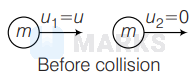
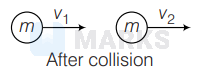
As coefficient of restitution, $e=\frac{v_2-v_1}{u_1-u_2}=\frac{v_2-v_1}{u-0}$
$\Rightarrow \quad v_2-v_1=e u$...(i)
By conservation of momentum,
Momentum before collision = Momentum after collision
$\begin{aligned} & m u=m v_1+m v_2 \\ & \Rightarrow \quad v_1+v_2=u \\ & \end{aligned}$...(ii)
On solving Eqs. (i) and (ii), we get
$\begin{aligned} & v_1=\frac{u}{2}(1-e) \text { and } v_2=\frac{u}{2}(1+e) \\ & \therefore \quad \frac{v_1}{v_2}=\frac{1-e}{1+e} \\ & \end{aligned}$
Looking for more such questions to practice?
Download the MARKS App - The ultimate prep app for IIT JEE & NEET with chapter-wise PYQs, revision notes, formula sheets, custom tests & much more.