Search any question & find its solution
Question:
Answered & Verified by Expert
A spherical capacitor consists of two concentric spherical conductors, held in position by suitable insulating supports Fig.

Show that the capacitance of a spherical capacitor is given by, $\mathrm{C}=\frac{4 \pi \varepsilon_0 \mathrm{r}_1 \mathrm{r}_2}{\mathrm{r}_1-\mathrm{r}_2}$
where $r_1$ and $r_2$ are the radii of outer and inner spheres, respectively.
Show that the capacitance of a spherical capacitor is given by, $\mathrm{C}=\frac{4 \pi \varepsilon_0 \mathrm{r}_1 \mathrm{r}_2}{\mathrm{r}_1-\mathrm{r}_2}$
where $r_1$ and $r_2$ are the radii of outer and inner spheres, respectively.
Solution:
1822 Upvotes
Verified Answer
Let $r_1$ is the radius of the outer sphere $B . r_2$ is the radius of the inner sphere $\mathrm{A}$.
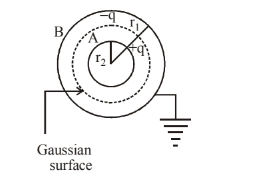
$+\mathrm{q}$ is the charge given to $\mathrm{A}$.
$-q$ is the charge induced to the inner surface of $B$.
$+q$ is the charge induced to the outer surface of $B$ which will flow to the earth as $B$ is earthed.
$\mathrm{V}$ is the potential difference between $\mathrm{A}$ and $\mathrm{B}$.
$\therefore \quad$ Capacitance $\mathrm{C}=\frac{\mathrm{q}}{\mathrm{V}}$
The electric field is non uniform in between the two spheres
So, $\mathrm{E}=\frac{\mathrm{dV}}{\mathrm{dr}} \Rightarrow \mathrm{dV}=\mathrm{Edr}$
$$
V=\int_A^B d V=\int_{r_2}^{r_1} E d r
$$
Electric field E at any point on the gaussian surface is radially outwards
By Gauss's theorem, $E=\frac{k q}{r^2}$
$$
\begin{aligned}
\therefore \quad \mathrm{V} &=\int_{\mathrm{r}_2}^{\mathrm{r}_1} \frac{\mathrm{kq}}{\mathrm{r}^2} \mathrm{dr}=\mathrm{kq} \int_{\mathrm{r}_2}^{\mathrm{r}_1} \frac{\mathrm{dr}}{\mathrm{r}^2}=\mathrm{kq}\left[-\frac{1}{\mathrm{r}}\right]_{\mathrm{r}_2}^{\mathrm{r}_2} \\
&=\mathrm{kq}\left[\frac{1}{\mathrm{r}_2}-\frac{1}{\mathrm{r}_1}\right]=\mathrm{kq}\left[\frac{\mathrm{r}_1-\mathrm{r}_2}{\mathrm{r}_1 \mathrm{r}_2}\right] \\
\mathrm{C}=\frac{\mathrm{q}}{\mathrm{V}}=\frac{\mathrm{q}}{\mathrm{kq} \frac{\mathrm{r}_1-\mathrm{r}_2}{\mathrm{r}_1 \mathrm{r}_2}}=\frac{4 \pi \varepsilon_0 \mathrm{r}_1 \mathrm{r}_2}{\mathrm{r}_1-\mathrm{r}_2} \\
\left.\because \quad \mathrm{k}=\frac{1}{4 \pi \varepsilon_0}\right]
\end{aligned}
$$
$+\mathrm{q}$ is the charge given to $\mathrm{A}$.
$-q$ is the charge induced to the inner surface of $B$.
$+q$ is the charge induced to the outer surface of $B$ which will flow to the earth as $B$ is earthed.
$\mathrm{V}$ is the potential difference between $\mathrm{A}$ and $\mathrm{B}$.
$\therefore \quad$ Capacitance $\mathrm{C}=\frac{\mathrm{q}}{\mathrm{V}}$
The electric field is non uniform in between the two spheres
So, $\mathrm{E}=\frac{\mathrm{dV}}{\mathrm{dr}} \Rightarrow \mathrm{dV}=\mathrm{Edr}$
$$
V=\int_A^B d V=\int_{r_2}^{r_1} E d r
$$
Electric field E at any point on the gaussian surface is radially outwards
By Gauss's theorem, $E=\frac{k q}{r^2}$
$$
\begin{aligned}
\therefore \quad \mathrm{V} &=\int_{\mathrm{r}_2}^{\mathrm{r}_1} \frac{\mathrm{kq}}{\mathrm{r}^2} \mathrm{dr}=\mathrm{kq} \int_{\mathrm{r}_2}^{\mathrm{r}_1} \frac{\mathrm{dr}}{\mathrm{r}^2}=\mathrm{kq}\left[-\frac{1}{\mathrm{r}}\right]_{\mathrm{r}_2}^{\mathrm{r}_2} \\
&=\mathrm{kq}\left[\frac{1}{\mathrm{r}_2}-\frac{1}{\mathrm{r}_1}\right]=\mathrm{kq}\left[\frac{\mathrm{r}_1-\mathrm{r}_2}{\mathrm{r}_1 \mathrm{r}_2}\right] \\
\mathrm{C}=\frac{\mathrm{q}}{\mathrm{V}}=\frac{\mathrm{q}}{\mathrm{kq} \frac{\mathrm{r}_1-\mathrm{r}_2}{\mathrm{r}_1 \mathrm{r}_2}}=\frac{4 \pi \varepsilon_0 \mathrm{r}_1 \mathrm{r}_2}{\mathrm{r}_1-\mathrm{r}_2} \\
\left.\because \quad \mathrm{k}=\frac{1}{4 \pi \varepsilon_0}\right]
\end{aligned}
$$
Looking for more such questions to practice?
Download the MARKS App - The ultimate prep app for IIT JEE & NEET with chapter-wise PYQs, revision notes, formula sheets, custom tests & much more.