Search any question & find its solution
Question:
Answered & Verified by Expert
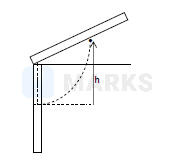
A thin uniform rod of length $\ell$ and mass $m$ is swinging freely about a horizontal axis passing through its end. Its maximum angular speed is $\omega$. Its centre of mass rises to a maximum height of
Options:
Solution:
1981 Upvotes
Verified Answer
The correct answer is:
$\frac{1}{6} \frac{\ell^2 \omega^2}{\mathrm{~g}}$
$\frac{1}{6} \frac{\ell^2 \omega^2}{\mathrm{~g}}$
$$
\begin{aligned}
& \text { } \\
& \text { T.E }=T . E_{\mathrm{f}} \\
& \frac{1}{2} I \omega^2=m g h \\
& \frac{1}{2} \times \frac{1}{3} m \ell^2 \omega^2=m g h \Rightarrow h=\frac{1}{6} \frac{\ell^2 \omega^2}{\mathrm{~g}}
\end{aligned}
$$
\begin{aligned}
& \text { } \\
& \text { T.E }=T . E_{\mathrm{f}} \\
& \frac{1}{2} I \omega^2=m g h \\
& \frac{1}{2} \times \frac{1}{3} m \ell^2 \omega^2=m g h \Rightarrow h=\frac{1}{6} \frac{\ell^2 \omega^2}{\mathrm{~g}}
\end{aligned}
$$
Looking for more such questions to practice?
Download the MARKS App - The ultimate prep app for IIT JEE & NEET with chapter-wise PYQs, revision notes, formula sheets, custom tests & much more.