Search any question & find its solution
Question:
Answered & Verified by Expert
A tuning fork vibrating with a frequency of $512 \mathrm{~Hz}$ is kept close to the open end of a tube filled with water (figure). The water level in the tube is gradually lowered. When the water level is $17 \mathrm{~cm}$ below the open end, maximum intensity of sound is heard. If the room temperature is $20^{\circ} \mathrm{C}$, calculate
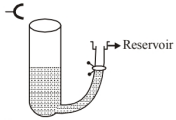
(a) speed of sound in air at room temperature.
(b) speed of sound in air at $0^{\circ} \mathrm{C}$.
(c) if the water in the tube is replaced with mercury, will there be any difference in your observations?
(a) speed of sound in air at room temperature.
(b) speed of sound in air at $0^{\circ} \mathrm{C}$.
(c) if the water in the tube is replaced with mercury, will there be any difference in your observations?
Solution:
1902 Upvotes
Verified Answer
(a) The pipe partially filled with water or mercury acts as one end open organ pipe.
In first harmonic one antinode and one node at water level formed so, first harmonic or at maximum intensity is heard at $L=17 \mathrm{~cm}$ so, shown in the diagram frequency of tuning fork $v=512 \mathrm{~Hz}$.
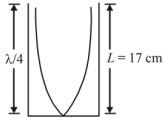
For observation of first maxima of intensity
So, $L=\frac{\lambda}{4}, \lambda=4 L$,
$$
\begin{aligned}
&\lambda=4 \times 17=4 \times 17 \times 10^{-2} \mathrm{~cm} \\
&v=v \lambda=512 \times 4 \times 17 \times 10^{-2}=348.16 \mathrm{~m} / \mathrm{s}
\end{aligned}
$$
So velocity of sound in air at room temperature $20^{\circ} \mathrm{C}$ is $348.16 \mathrm{~m} / \mathrm{s}\left(v_{20}\right)$.
(b) As we know that $v \propto \sqrt{T}$ where temperature $(T)$ is in kelving.
$$
\begin{aligned}
\frac{v_1}{v_2} & \propto \sqrt{\frac{T_1}{T_2}} \\
\frac{v_{20}}{v_0} &=\sqrt{\frac{273+20}{273+0}}=\sqrt{\frac{293}{273}} \\
v_0 &=v_{20} \sqrt{\frac{273}{293}}=v_0 \sqrt{0.9317} \\
&=348.16 \times 0.96526=336 \mathrm{~m} / \mathrm{sec} .
\end{aligned}
$$
(c) Water and mercury in tube reflects the sound into air column to form stationary wave and resonance will be observed at $17 \mathrm{~cm}$ length of air column, only intensity of sound heard will be larger due to more complete reflection of the sound waves at the mercury surface because mercury is more denser than water.
(b) As we know that $v \propto \sqrt{T}$ where temperature $(T)$ is in kelving.
$$
\begin{aligned}
\frac{v_1}{v_2} & \propto \sqrt{\frac{T_1}{T_2}} \\
\frac{v_{20}}{v_0} &=\sqrt{\frac{273+20}{273+0}}=\sqrt{\frac{293}{273}} \\
v_0 &=v_{20} \sqrt{\frac{273}{293}}=v_0 \sqrt{0.9317} \\
&=348.16 \times 0.96526=336 \mathrm{~m} / \mathrm{sec} .
\end{aligned}
$$
(c) Water and mercury in tube reflects the sound into air column to form stationary wave and resonance will be observed at $17 \mathrm{~cm}$ length of air column, only intensity of sound heard will be larger due to more complete reflection of the sound waves at the mercury surface because mercury is more denser than water.
In first harmonic one antinode and one node at water level formed so, first harmonic or at maximum intensity is heard at $L=17 \mathrm{~cm}$ so, shown in the diagram frequency of tuning fork $v=512 \mathrm{~Hz}$.
For observation of first maxima of intensity
So, $L=\frac{\lambda}{4}, \lambda=4 L$,
$$
\begin{aligned}
&\lambda=4 \times 17=4 \times 17 \times 10^{-2} \mathrm{~cm} \\
&v=v \lambda=512 \times 4 \times 17 \times 10^{-2}=348.16 \mathrm{~m} / \mathrm{s}
\end{aligned}
$$
So velocity of sound in air at room temperature $20^{\circ} \mathrm{C}$ is $348.16 \mathrm{~m} / \mathrm{s}\left(v_{20}\right)$.
(b) As we know that $v \propto \sqrt{T}$ where temperature $(T)$ is in kelving.
$$
\begin{aligned}
\frac{v_1}{v_2} & \propto \sqrt{\frac{T_1}{T_2}} \\
\frac{v_{20}}{v_0} &=\sqrt{\frac{273+20}{273+0}}=\sqrt{\frac{293}{273}} \\
v_0 &=v_{20} \sqrt{\frac{273}{293}}=v_0 \sqrt{0.9317} \\
&=348.16 \times 0.96526=336 \mathrm{~m} / \mathrm{sec} .
\end{aligned}
$$
(c) Water and mercury in tube reflects the sound into air column to form stationary wave and resonance will be observed at $17 \mathrm{~cm}$ length of air column, only intensity of sound heard will be larger due to more complete reflection of the sound waves at the mercury surface because mercury is more denser than water.
(b) As we know that $v \propto \sqrt{T}$ where temperature $(T)$ is in kelving.
$$
\begin{aligned}
\frac{v_1}{v_2} & \propto \sqrt{\frac{T_1}{T_2}} \\
\frac{v_{20}}{v_0} &=\sqrt{\frac{273+20}{273+0}}=\sqrt{\frac{293}{273}} \\
v_0 &=v_{20} \sqrt{\frac{273}{293}}=v_0 \sqrt{0.9317} \\
&=348.16 \times 0.96526=336 \mathrm{~m} / \mathrm{sec} .
\end{aligned}
$$
(c) Water and mercury in tube reflects the sound into air column to form stationary wave and resonance will be observed at $17 \mathrm{~cm}$ length of air column, only intensity of sound heard will be larger due to more complete reflection of the sound waves at the mercury surface because mercury is more denser than water.
Looking for more such questions to practice?
Download the MARKS App - The ultimate prep app for IIT JEE & NEET with chapter-wise PYQs, revision notes, formula sheets, custom tests & much more.