Search any question & find its solution
Question:
Answered & Verified by Expert
An ammeter of resistance ' $R$ ' gives a full scale deflection when a current of 2 A passes through it. If it is to be converted into an ammeter to measure maximum current of $10 \mathrm{~A}$, the required shunt is
Options:
Solution:
2535 Upvotes
Verified Answer
The correct answer is:
$\frac{\mathrm{R}}{4}$
Consider the diagram below:
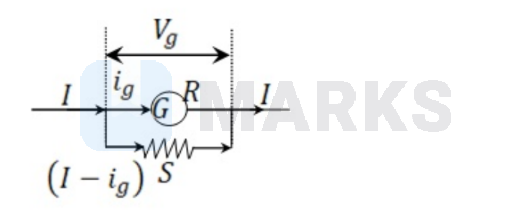
Given, $\mathrm{i}_{\mathrm{g}}=2 \mathrm{~A}$ is current for maximum deflection, $\mathrm{R}=\mathrm{R}_{\mathrm{g}}$ is the resistance of galvanometer, $\mathrm{I}=10 \mathrm{~A}$ is the maximum current to be measured by the ammeter.
On considering same potential drop across the galvanometer and the shunt resistance:
$\Rightarrow\left(I-i_g\right) S=i_g R$.
On plugging in the given values,
$(10 A-2 A) S=(2 A) R$
The shunt resistance $S$ can be written as: $S=\frac{R}{4}$
Given, $\mathrm{i}_{\mathrm{g}}=2 \mathrm{~A}$ is current for maximum deflection, $\mathrm{R}=\mathrm{R}_{\mathrm{g}}$ is the resistance of galvanometer, $\mathrm{I}=10 \mathrm{~A}$ is the maximum current to be measured by the ammeter.
On considering same potential drop across the galvanometer and the shunt resistance:
$\Rightarrow\left(I-i_g\right) S=i_g R$.
On plugging in the given values,
$(10 A-2 A) S=(2 A) R$
The shunt resistance $S$ can be written as: $S=\frac{R}{4}$
Looking for more such questions to practice?
Download the MARKS App - The ultimate prep app for IIT JEE & NEET with chapter-wise PYQs, revision notes, formula sheets, custom tests & much more.