Search any question & find its solution
Question:
Answered & Verified by Expert
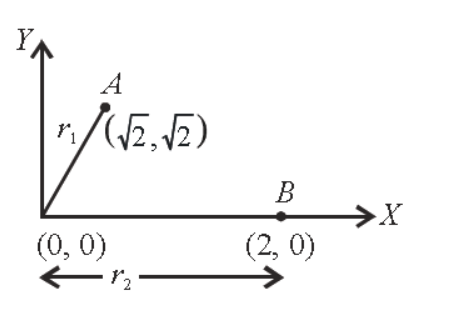
An electric charge $10^{-3} \mu \mathrm{C}$ is placed at the origin $(0,0)$ of $(x-y)$ co-ordinate system. Two points $A$ and $B$ are situated at $(\sqrt{2}, \sqrt{2})$ and $(2,0)$ respectively. The potential difference between the points $A$ and $B$ will be
Options:
Solution:
1268 Upvotes
Verified Answer
The correct answer is:
zero
$$
\begin{aligned}
& \text { } \overrightarrow{r_1}=\sqrt{2} \hat{i}+\sqrt{2} \hat{j} \\
& \left|\vec{r}_1\right|=r_1=\sqrt{(\sqrt{2})^2+(\sqrt{2})^2}=2
\end{aligned}
$$
$$
\begin{aligned}
& \vec{r}_2=2 \hat{i}+0 \hat{j} \\
& \text { or }\left|\vec{r}_2\right|=r_2=2
\end{aligned}
$$
Potential at point $A$ is
$$
\begin{aligned}
& V_A=\frac{1 q}{4 \pi \varepsilon_0 r_1} \\
& =\frac{1}{4 \pi \varepsilon_0} \frac{10^{-3} \times 10^{-6}}{2}
\end{aligned}
$$
Potential at point $B$ is
$$
\begin{aligned}
& \quad V_B=\frac{1}{4 \pi \varepsilon_0} \frac{q}{r_2}=\frac{1}{4 \pi \varepsilon_0} \frac{10^{-3} \times 10^{-6}}{2} \\
& \therefore \quad V_A-V_B=0 .
\end{aligned}
$$
\begin{aligned}
& \text { } \overrightarrow{r_1}=\sqrt{2} \hat{i}+\sqrt{2} \hat{j} \\
& \left|\vec{r}_1\right|=r_1=\sqrt{(\sqrt{2})^2+(\sqrt{2})^2}=2
\end{aligned}
$$
$$
\begin{aligned}
& \vec{r}_2=2 \hat{i}+0 \hat{j} \\
& \text { or }\left|\vec{r}_2\right|=r_2=2
\end{aligned}
$$
Potential at point $A$ is
$$
\begin{aligned}
& V_A=\frac{1 q}{4 \pi \varepsilon_0 r_1} \\
& =\frac{1}{4 \pi \varepsilon_0} \frac{10^{-3} \times 10^{-6}}{2}
\end{aligned}
$$
Potential at point $B$ is
$$
\begin{aligned}
& \quad V_B=\frac{1}{4 \pi \varepsilon_0} \frac{q}{r_2}=\frac{1}{4 \pi \varepsilon_0} \frac{10^{-3} \times 10^{-6}}{2} \\
& \therefore \quad V_A-V_B=0 .
\end{aligned}
$$
Looking for more such questions to practice?
Download the MARKS App - The ultimate prep app for IIT JEE & NEET with chapter-wise PYQs, revision notes, formula sheets, custom tests & much more.