Search any question & find its solution
Question:
Answered & Verified by Expert
An electron emitted by a heated cathode and accelerated through a potential difference of $2.0 \mathrm{k} \mathbf{V}$, enters a region with uniform magnetic field of $0.15 \mathrm{~T}$. Determine the trajectory of the electron if the field (a) is transverse to its initial velocity, (b) makes an angle of $30^{\circ}$ with the initial velocity.
Solution:
2554 Upvotes
Verified Answer
A electron which is accelerated by a potential difference of $2.0 \mathrm{kV}$ will have a kinetic energy gained $2000 \mathrm{eV}$. $E=1 / 2 m_{\mathrm{e}} v^2=2000 \times 1.6 \times 10^{-19}$
$v=\sqrt{\frac{4 \times 1.6 \times 10^{-16}}{9 \times 10^{-37}}}=2.66 \times 10^7 \mathrm{~ms}^{-1}$
(a) When the electron enters in the uniform magnetic field which is normal to the velocity of electron follows a circular path of radius.
$$
\begin{aligned}
r &=\frac{m v}{B q}=\frac{9 \times 10^{-31} \times 2.66 \times 10^7}{0.15 \times 1.6 \times 10^{-19}} \\
&=99.75 \times 10^{-1} \mathrm{~m} \approx 1 \mathrm{~mm}
\end{aligned}
$$
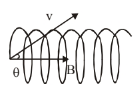
(b) When the magnetic field makes an angle $30^{\circ}$ with the initial velocity, the trajectory of the electron becomes helical.
radius of the helical path is
$$
\begin{gathered}
r=\frac{m v \sin \theta}{B q} \\
r=99.75 \times 10^{-7} \times \frac{1}{2}
\end{gathered}
$$
$$
\mathrm{r}=49.875 \times 10^{-7} \mathrm{~m} \approx 0.5 \mathrm{~mm}
$$
Pitch of the helical path is
$$
\begin{aligned}
&\text { Pitch }=T \times v \cos \theta=\frac{2 \pi m}{B q} \times v \cos \theta \\
&=\frac{2 \pi \times 9 \times 10^{-31} \times 2.66 \times 10^7}{0.15 \times 1.6 \times 10^{-19}}=\frac{\sqrt{3}}{2} \\
&=542.5 \times 10^{-5} \mathrm{~m}
\end{aligned}
$$
So, pitch $=5.42 \mathrm{~mm}$.
$v=\sqrt{\frac{4 \times 1.6 \times 10^{-16}}{9 \times 10^{-37}}}=2.66 \times 10^7 \mathrm{~ms}^{-1}$
(a) When the electron enters in the uniform magnetic field which is normal to the velocity of electron follows a circular path of radius.
$$
\begin{aligned}
r &=\frac{m v}{B q}=\frac{9 \times 10^{-31} \times 2.66 \times 10^7}{0.15 \times 1.6 \times 10^{-19}} \\
&=99.75 \times 10^{-1} \mathrm{~m} \approx 1 \mathrm{~mm}
\end{aligned}
$$
(b) When the magnetic field makes an angle $30^{\circ}$ with the initial velocity, the trajectory of the electron becomes helical.
radius of the helical path is
$$
\begin{gathered}
r=\frac{m v \sin \theta}{B q} \\
r=99.75 \times 10^{-7} \times \frac{1}{2}
\end{gathered}
$$
$$
\mathrm{r}=49.875 \times 10^{-7} \mathrm{~m} \approx 0.5 \mathrm{~mm}
$$
Pitch of the helical path is
$$
\begin{aligned}
&\text { Pitch }=T \times v \cos \theta=\frac{2 \pi m}{B q} \times v \cos \theta \\
&=\frac{2 \pi \times 9 \times 10^{-31} \times 2.66 \times 10^7}{0.15 \times 1.6 \times 10^{-19}}=\frac{\sqrt{3}}{2} \\
&=542.5 \times 10^{-5} \mathrm{~m}
\end{aligned}
$$
So, pitch $=5.42 \mathrm{~mm}$.
Looking for more such questions to practice?
Download the MARKS App - The ultimate prep app for IIT JEE & NEET with chapter-wise PYQs, revision notes, formula sheets, custom tests & much more.