Search any question & find its solution
Question:
Answered & Verified by Expert
An e.m.f. $\mathrm{E}=\mathrm{E}_{0} \sin \omega \mathrm{t}$ is applied to a circuit containing 'L' and 'R' in series.
If $X_{L}=R$, then the power dissipated in the circuit is
Options:
If $X_{L}=R$, then the power dissipated in the circuit is
Solution:
1502 Upvotes
Verified Answer
The correct answer is:
$\frac{\mathrm{E}_{0}^{2}}{2 \mathrm{R}}$
$\mathrm{E}=\mathrm{E}_{0} \sin \omega \mathrm{t}$
$P=\frac{E_{0}}{\sqrt{2}} \times \frac{I_{0}}{\sqrt{2}} \cos \theta$
$=\frac{E_{0}}{\sqrt{2}} \times \frac{E_{0}}{\sqrt{2} Z} \times \frac{R}{Z}$
$=\frac{E_{0}^{2} R}{2 Z^{2}} \quad \quad Z^{2}=R^{2}+\omega L^{2}=2 R^{2}$
$=\frac{E_{0}^{2} R}{4 R^{2}}=\frac{E_{0}^{2}}{4 R}$
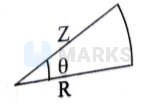
$P=\frac{E_{0}}{\sqrt{2}} \times \frac{I_{0}}{\sqrt{2}} \cos \theta$
$=\frac{E_{0}}{\sqrt{2}} \times \frac{E_{0}}{\sqrt{2} Z} \times \frac{R}{Z}$
$=\frac{E_{0}^{2} R}{2 Z^{2}} \quad \quad Z^{2}=R^{2}+\omega L^{2}=2 R^{2}$
$=\frac{E_{0}^{2} R}{4 R^{2}}=\frac{E_{0}^{2}}{4 R}$
Looking for more such questions to practice?
Download the MARKS App - The ultimate prep app for IIT JEE & NEET with chapter-wise PYQs, revision notes, formula sheets, custom tests & much more.