Search any question & find its solution
Question:
Answered & Verified by Expert
Calculate potential on the axis of a disc of radius $\mathrm{R}$ due to a charge $\mathrm{Q}$ uniformly distributed on its surface.
Solution:
1480 Upvotes
Verified Answer
Consider a point $\mathrm{P}$ lies at a distance $\mathrm{x}$ from the centre of the disk or perpendicular to the plane of disc. Let the disc is divided into a number of charged rings as shown in figure.
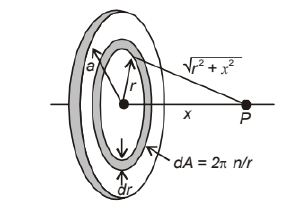
The electric potential of each ring, of radius $r$ and thickness $\mathrm{dr}$, have charge dq is
$$
\sigma \mathrm{dA}=\sigma 2 \pi d r
$$
and potential is $\mathrm{dv}$ due to ring at point $\mathrm{P}$, will be
$$
\mathrm{dV}=\frac{\mathrm{K}_{\mathrm{e}} \mathrm{dq}}{\mathrm{r}^{\prime}}
$$
$\mathrm{dq}$ is the charge on the ring $=\sigma$. area of ring
$$
\begin{aligned}
\mathrm{dq} &=-\left(\pi(\mathrm{r}+\mathrm{dr})^2-\pi \mathrm{r}^2\right] \\
&=-\pi\left[(\mathrm{r}+\mathrm{dr})^2-\mathrm{r}^2\right] \\
\mathrm{dq} &=\sigma \pi\left[\mathrm{r}^2+\mathrm{dr}^2+2 \mathrm{rdr}-\mathrm{r}^2\right]
\end{aligned}
$$
Because dr is very small therefore $\mathrm{dr}^2$ is negligible, so
$$
\mathrm{dq}=(2 \pi \mathrm{r} \sigma \mathrm{dr})
$$
and, $\mathrm{dV}=\frac{\mathrm{k}_{\mathrm{e}} \mathrm{dq}}{\sqrt{\mathrm{r}^2+\mathrm{x}^2}} \quad\left(\therefore \mathrm{r}^{\prime}=\sqrt{\mathrm{r}^2+\mathrm{x}^2}\right)$
$$
=\frac{\mathrm{k}_{\mathrm{e}} \sigma 2 \pi \mathrm{rdr}}{\sqrt{\mathrm{r}^2+\mathrm{x}^2}} \quad(\therefore \mathrm{dq}=2 \pi \mathrm{r} \sigma \mathrm{dr})
$$
where $\mathrm{k}_{\mathrm{e}}=\frac{1}{4 \pi \varepsilon_0}$ the total electric potential at $\mathrm{P}$, is
$$
\begin{aligned}
\mathrm{V}=& \pi \mathrm{k}_{\mathrm{e}} \sigma \int_0^{\mathrm{a}} \frac{2 \mathrm{rdr}}{\sqrt{\mathrm{r}^2+\mathrm{x}^2}} \\
&=\pi \mathrm{k}_{\mathrm{e}} \sigma \int_0^{\mathrm{a}}\left(\mathrm{r}^2+\mathrm{x}^2\right)^{-1 / 2} 2 \mathrm{rdr} \\
\mathrm{V}=& 2 \pi \mathrm{k}_{\mathrm{e}} \sigma\left[\left(\mathrm{x}^2+\mathrm{a}^2\right)^{1 / 2}-\mathrm{x}\right]
\end{aligned}
$$
So, we have by substring
$$
\begin{aligned}
&\mathrm{k}_{\mathrm{e}}=\frac{1}{4 \pi \varepsilon_0} \\
&\mathrm{~V}=\frac{1}{4 \pi \varepsilon_0} \frac{2 \mathrm{Q}}{\mathrm{a}^2}\left[\sqrt{\mathrm{x}^2+\mathrm{a}^2}-\mathrm{x}\right]
\end{aligned}
$$
So, $V=\frac{1}{4 \pi \varepsilon_0} \frac{2 Q}{R^2}\left[\sqrt{\mathrm{x}^2+\mathrm{R}^2}-\mathrm{x}\right]$
The electric potential of each ring, of radius $r$ and thickness $\mathrm{dr}$, have charge dq is
$$
\sigma \mathrm{dA}=\sigma 2 \pi d r
$$
and potential is $\mathrm{dv}$ due to ring at point $\mathrm{P}$, will be
$$
\mathrm{dV}=\frac{\mathrm{K}_{\mathrm{e}} \mathrm{dq}}{\mathrm{r}^{\prime}}
$$
$\mathrm{dq}$ is the charge on the ring $=\sigma$. area of ring
$$
\begin{aligned}
\mathrm{dq} &=-\left(\pi(\mathrm{r}+\mathrm{dr})^2-\pi \mathrm{r}^2\right] \\
&=-\pi\left[(\mathrm{r}+\mathrm{dr})^2-\mathrm{r}^2\right] \\
\mathrm{dq} &=\sigma \pi\left[\mathrm{r}^2+\mathrm{dr}^2+2 \mathrm{rdr}-\mathrm{r}^2\right]
\end{aligned}
$$
Because dr is very small therefore $\mathrm{dr}^2$ is negligible, so
$$
\mathrm{dq}=(2 \pi \mathrm{r} \sigma \mathrm{dr})
$$
and, $\mathrm{dV}=\frac{\mathrm{k}_{\mathrm{e}} \mathrm{dq}}{\sqrt{\mathrm{r}^2+\mathrm{x}^2}} \quad\left(\therefore \mathrm{r}^{\prime}=\sqrt{\mathrm{r}^2+\mathrm{x}^2}\right)$
$$
=\frac{\mathrm{k}_{\mathrm{e}} \sigma 2 \pi \mathrm{rdr}}{\sqrt{\mathrm{r}^2+\mathrm{x}^2}} \quad(\therefore \mathrm{dq}=2 \pi \mathrm{r} \sigma \mathrm{dr})
$$
where $\mathrm{k}_{\mathrm{e}}=\frac{1}{4 \pi \varepsilon_0}$ the total electric potential at $\mathrm{P}$, is
$$
\begin{aligned}
\mathrm{V}=& \pi \mathrm{k}_{\mathrm{e}} \sigma \int_0^{\mathrm{a}} \frac{2 \mathrm{rdr}}{\sqrt{\mathrm{r}^2+\mathrm{x}^2}} \\
&=\pi \mathrm{k}_{\mathrm{e}} \sigma \int_0^{\mathrm{a}}\left(\mathrm{r}^2+\mathrm{x}^2\right)^{-1 / 2} 2 \mathrm{rdr} \\
\mathrm{V}=& 2 \pi \mathrm{k}_{\mathrm{e}} \sigma\left[\left(\mathrm{x}^2+\mathrm{a}^2\right)^{1 / 2}-\mathrm{x}\right]
\end{aligned}
$$
So, we have by substring
$$
\begin{aligned}
&\mathrm{k}_{\mathrm{e}}=\frac{1}{4 \pi \varepsilon_0} \\
&\mathrm{~V}=\frac{1}{4 \pi \varepsilon_0} \frac{2 \mathrm{Q}}{\mathrm{a}^2}\left[\sqrt{\mathrm{x}^2+\mathrm{a}^2}-\mathrm{x}\right]
\end{aligned}
$$
So, $V=\frac{1}{4 \pi \varepsilon_0} \frac{2 Q}{R^2}\left[\sqrt{\mathrm{x}^2+\mathrm{R}^2}-\mathrm{x}\right]$
Looking for more such questions to practice?
Download the MARKS App - The ultimate prep app for IIT JEE & NEET with chapter-wise PYQs, revision notes, formula sheets, custom tests & much more.