Search any question & find its solution
Question:
Answered & Verified by Expert
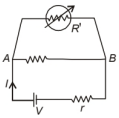
Consider a simple circuit shown in figure stands for a variable resistance $R^{\prime}$. $R^{\prime}$ can vary from $R_0$ to infinity, $r$ is internal resistance of the battery $\left(\mathrm{r} \ll \mathrm{R} \ll \mathrm{R}_0\right)$.
Options:
Solution:
2712 Upvotes
Verified Answer
The correct answers are:
Potential drop across $\mathrm{AB}$ is nearly constant as $\mathrm{R}^{\prime}$ is varied
,
$\mathrm{I} \geq \frac{\mathrm{V}}{\mathrm{r}+\mathrm{R}}$ always
Potential drop across $\mathrm{AB}$ is nearly constant as $\mathrm{R}^{\prime}$ is varied
,
$\mathrm{I} \geq \frac{\mathrm{V}}{\mathrm{r}+\mathrm{R}}$ always
In parallel combination of resistances, the equivalent resistance is smaller than smallest resistance $(R)$ present in combination.
Here, the potential drop is taking place across $\mathrm{AB}$ and $\mathrm{r}$. Since the equivalent resistance of parallel combination of
$R$ and $R^{\prime}$ is always less than $R$, so, $I \geq \frac{V}{r+R}$ always
Here, the potential drop is taking place across $\mathrm{AB}$ and $\mathrm{r}$. Since the equivalent resistance of parallel combination of
$R$ and $R^{\prime}$ is always less than $R$, so, $I \geq \frac{V}{r+R}$ always
Looking for more such questions to practice?
Download the MARKS App - The ultimate prep app for IIT JEE & NEET with chapter-wise PYQs, revision notes, formula sheets, custom tests & much more.