Search any question & find its solution
Question:
Answered & Verified by Expert
Consider the following linear equations
$$
a x+b y+c z=0, b x+c y+a z=0, c x+a y+b z=0
$$
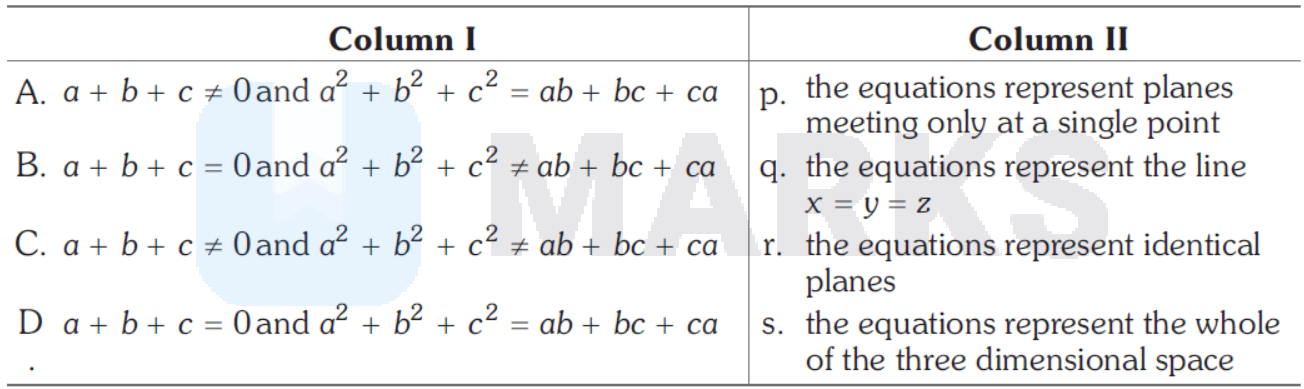
Match the conditions/expressions in Column I with statements in Column II.
Options:
$$
a x+b y+c z=0, b x+c y+a z=0, c x+a y+b z=0
$$
Match the conditions/expressions in Column I with statements in Column II.
Solution:
2558 Upvotes
Verified Answer
The correct answer is:
A-r; B-q; C-p; D-s
A-r; B-q; C-p; D-s
Let $\Delta=\left|\begin{array}{lll}a & b & c \\ b & c & a \\ c & a & b\end{array}\right|=-\frac{1}{2}(a+b+c)\left[(a-b)^2+(b-c)^2+(c-a)^2\right]$
(A) If $a+b+c \neq 0$ and $a^2+b^2+c^2=a b+b c+c a$
$$
\Rightarrow \quad \Delta=0 \text { and } a=b=c \neq 0
$$
The equations represents identical planes.
(B) $a+b+c=0$ and $a^2+b^2+c^2 \neq a b+b c+c a$
$$
\Rightarrow \quad \Delta=0
$$
The equations have infinitely many solutions.
$$
\begin{array}{rlrl}
& & a x+b y & =(a+b) z \\
\Rightarrow & b x+c y & =(b+c) z \\
\Rightarrow & & \left(b^2-a c\right) y & =\left(b^2-a c\right) z \Rightarrow y=z \\
\Rightarrow & a x+b y+c y & =0 \\
& a x & =a y \Rightarrow x=y=z
\end{array}
$$
(C) $a+b+c \neq 0$ and $a^2+b^2+c^2 \neq a b+b c+c a$
$$
\Rightarrow \quad \Delta \neq 0
$$
The equation represent planes meeting at only one point.
(D) $a+b+c=0$ and $a^2+b^2+c^2=a b+b c+c a$
$$
\Rightarrow \quad a=b=c=0
$$
The equations represent whole of the three dimensional space.
(A) If $a+b+c \neq 0$ and $a^2+b^2+c^2=a b+b c+c a$
$$
\Rightarrow \quad \Delta=0 \text { and } a=b=c \neq 0
$$
The equations represents identical planes.
(B) $a+b+c=0$ and $a^2+b^2+c^2 \neq a b+b c+c a$
$$
\Rightarrow \quad \Delta=0
$$
The equations have infinitely many solutions.
$$
\begin{array}{rlrl}
& & a x+b y & =(a+b) z \\
\Rightarrow & b x+c y & =(b+c) z \\
\Rightarrow & & \left(b^2-a c\right) y & =\left(b^2-a c\right) z \Rightarrow y=z \\
\Rightarrow & a x+b y+c y & =0 \\
& a x & =a y \Rightarrow x=y=z
\end{array}
$$
(C) $a+b+c \neq 0$ and $a^2+b^2+c^2 \neq a b+b c+c a$
$$
\Rightarrow \quad \Delta \neq 0
$$
The equation represent planes meeting at only one point.
(D) $a+b+c=0$ and $a^2+b^2+c^2=a b+b c+c a$
$$
\Rightarrow \quad a=b=c=0
$$
The equations represent whole of the three dimensional space.
Looking for more such questions to practice?
Download the MARKS App - The ultimate prep app for IIT JEE & NEET with chapter-wise PYQs, revision notes, formula sheets, custom tests & much more.