Search any question & find its solution
Question:
Answered & Verified by Expert
Enumerate the differences between asexual and sexual reproduction. Describe the types of asexual reproduction exhibited by unicellular organisms.
Solution:
1707 Upvotes
Verified Answer
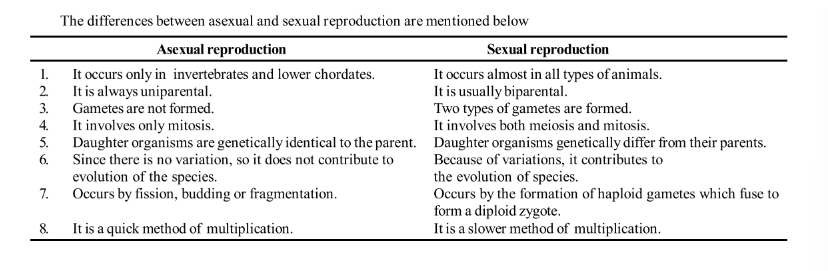
In unicellular organisms, such as monerans and protists in plants and certain animals, asexual reproduction occurs.
(i) Binary Fission - This is a mode of asexual reproduction in which the parent organism divides into two equal halves, each half forming an independent daughter organism. e.g., Amoeba, Euglena, Paramecium.
(ii) Budding-This is a mode of asexual reproduction in which organism is formed from a small projection i.e., the bud, arising from the parent body. e.g., yeast Hydra, salpa, etc
(iii) Fragmentation - This is a mode of asexual reproduction in which the parent body breaks into two or more fragment. Each body fragment develops into an organism. e.g., sponges, Selaginella.
(iv) Gemmule - This is a mode of asexual reproduction in which internal buds, called gemmules are involved. These are asexually reproduced mass of cells, which are capable of developing into a new organism. e.g., sponges.
(v) Sporulation - This is a mode of asexual reproduction in which dispersive structure called spores are released from the parent body which later germinates under favourable conditions to form new individuals.
(a) Zoospores i.e. Motile spores are found in aquatic animals. e.g., Albugo, Chlamydomonas.
(b) Sporangiospores i.e., Non-motile spores (e.g., Rhizopus, Mucor) and conidia e.g., Penicillium.
Looking for more such questions to practice?
Download the MARKS App - The ultimate prep app for IIT JEE & NEET with chapter-wise PYQs, revision notes, formula sheets, custom tests & much more.