Search any question & find its solution
Question:
Answered & Verified by Expert
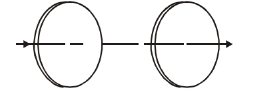
Figure shows a capacitor made of two circular plates each of radius $12 \mathrm{~cm}$, and separated by $5.0 \mathrm{~cm}$. The capacitor is being changed by an external source (not shown in the figure). The charging current is constant and equal to $0.15 \mathrm{~A}$.
(a) Calculate the capacitance and the rate of change of potential difference between the plates.
(b) Obtain the displacement current across the plates.
(c) Is Kirchhoff's first rule (junction rule) valid at each plate of the capacitor? Explain.
(a) Calculate the capacitance and the rate of change of potential difference between the plates.
(b) Obtain the displacement current across the plates.
(c) Is Kirchhoff's first rule (junction rule) valid at each plate of the capacitor? Explain.
Solution:
1205 Upvotes
Verified Answer
(a) Here, $r=12 \mathrm{~cm}, \mathrm{~d}=5 \mathrm{~cm}, \mathrm{I}=0.15 \mathrm{~A}$
Capacitance of the capacitor $C=\frac{\varepsilon_0 \pi r^2}{d}$
$$
\begin{aligned}
&=\frac{8.85 \times 10^{-12} \times 3.14 \times(0.12)^2}{5 \times 10^{-2}}=80.1 \mathrm{pF} \\
&\frac{\mathrm{dQ}}{\mathrm{dt}}=\mathrm{C} \frac{\mathrm{dV}}{\mathrm{dt}} \\
&\Rightarrow \frac{\mathrm{dV}}{\mathrm{dt}}=\frac{0.15}{80.1 \times 10^{-12}}=1.87 \times 10^9 \mathrm{Vs}^{-1}
\end{aligned}
$$
(b) The displacement current is due to time varying electric field and is given by,
$$
\begin{aligned}
&\mathrm{i}_{\mathrm{D}}=\varepsilon_0 \frac{\mathrm{d} \phi_{\mathrm{E}}}{\mathrm{dt}}=\varepsilon_{\mathrm{o}} \frac{\mathrm{d}}{\mathrm{dt}}(\mathrm{EA})\left(\because \phi_{\mathrm{E}}=\mathrm{EA}\right) \\
&\therefore \quad \mathrm{i}_{\mathrm{D}}=\varepsilon_0 \mathrm{~A} \frac{\mathrm{dE}}{\mathrm{dt}}=\varepsilon_0 \mathrm{~A} \frac{\mathrm{d}}{\mathrm{dt}}\left(\frac{\mathrm{Q}}{\varepsilon_0 \mathrm{~A}}\right)=\frac{\mathrm{dQ}}{\mathrm{dt}} \\
&\left(\because \mathrm{E}=\frac{\mathrm{Q}}{\varepsilon_0 \mathrm{~A}}\right) \Rightarrow \mathrm{i}_{\mathrm{D}}=\mathrm{i}=0.15 \mathrm{~A} .
\end{aligned}
$$
(c) Yes the total current is the sum of conduction current and the displacement current.
Capacitance of the capacitor $C=\frac{\varepsilon_0 \pi r^2}{d}$
$$
\begin{aligned}
&=\frac{8.85 \times 10^{-12} \times 3.14 \times(0.12)^2}{5 \times 10^{-2}}=80.1 \mathrm{pF} \\
&\frac{\mathrm{dQ}}{\mathrm{dt}}=\mathrm{C} \frac{\mathrm{dV}}{\mathrm{dt}} \\
&\Rightarrow \frac{\mathrm{dV}}{\mathrm{dt}}=\frac{0.15}{80.1 \times 10^{-12}}=1.87 \times 10^9 \mathrm{Vs}^{-1}
\end{aligned}
$$
(b) The displacement current is due to time varying electric field and is given by,
$$
\begin{aligned}
&\mathrm{i}_{\mathrm{D}}=\varepsilon_0 \frac{\mathrm{d} \phi_{\mathrm{E}}}{\mathrm{dt}}=\varepsilon_{\mathrm{o}} \frac{\mathrm{d}}{\mathrm{dt}}(\mathrm{EA})\left(\because \phi_{\mathrm{E}}=\mathrm{EA}\right) \\
&\therefore \quad \mathrm{i}_{\mathrm{D}}=\varepsilon_0 \mathrm{~A} \frac{\mathrm{dE}}{\mathrm{dt}}=\varepsilon_0 \mathrm{~A} \frac{\mathrm{d}}{\mathrm{dt}}\left(\frac{\mathrm{Q}}{\varepsilon_0 \mathrm{~A}}\right)=\frac{\mathrm{dQ}}{\mathrm{dt}} \\
&\left(\because \mathrm{E}=\frac{\mathrm{Q}}{\varepsilon_0 \mathrm{~A}}\right) \Rightarrow \mathrm{i}_{\mathrm{D}}=\mathrm{i}=0.15 \mathrm{~A} .
\end{aligned}
$$
(c) Yes the total current is the sum of conduction current and the displacement current.
Looking for more such questions to practice?
Download the MARKS App - The ultimate prep app for IIT JEE & NEET with chapter-wise PYQs, revision notes, formula sheets, custom tests & much more.