Search any question & find its solution
Question:
Answered & Verified by Expert
Four resistors, $100 \Omega, 200 \Omega, 300 \Omega$ and $400 \Omega$ are connected to form four sides of a square. The resistors can be connected in any order. What is the maximum possible equivalent resistance across the diagonal of the square?
Options:
Solution:
1544 Upvotes
Verified Answer
The correct answer is:
$250 \Omega$
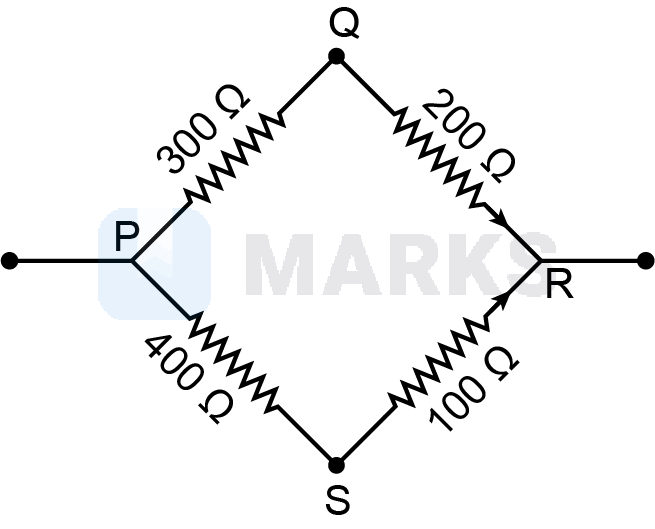
For maximum equivalent resistance across the diagonal of the square, the given resistors connected as
Resistance of $P Q R$ arm, $R_{1}=300+200=500 \Omega$
Resistance of $P S R$ arm, $R_{2}=400+100 \Omega=500 \Omega$
The equivalent resistance between $P$ and $R$.
$$
\begin{aligned}
\frac{1}{R_{e q}} &=\frac{1}{R_{1}}+\frac{1}{R_{2}} \\
&=\frac{1}{500}+\frac{1}{500}=\frac{1+1}{500} \\
\therefore \quad R_{e q} &=\frac{500}{2}=250 \Omega
\end{aligned}
$$
Resistance of $P Q R$ arm, $R_{1}=300+200=500 \Omega$
Resistance of $P S R$ arm, $R_{2}=400+100 \Omega=500 \Omega$
The equivalent resistance between $P$ and $R$.
$$
\begin{aligned}
\frac{1}{R_{e q}} &=\frac{1}{R_{1}}+\frac{1}{R_{2}} \\
&=\frac{1}{500}+\frac{1}{500}=\frac{1+1}{500} \\
\therefore \quad R_{e q} &=\frac{500}{2}=250 \Omega
\end{aligned}
$$
Looking for more such questions to practice?
Download the MARKS App - The ultimate prep app for IIT JEE & NEET with chapter-wise PYQs, revision notes, formula sheets, custom tests & much more.