Search any question & find its solution
Question:
Answered & Verified by Expert
If a parallelogram is formed with two sides represented by vectors \( \vec{a} \) and \( \vec{b} \), then \( \vec{a}+\vec{b} \) represented the
Options:
Solution:
1119 Upvotes
Verified Answer
The correct answer is:
Both of the above.
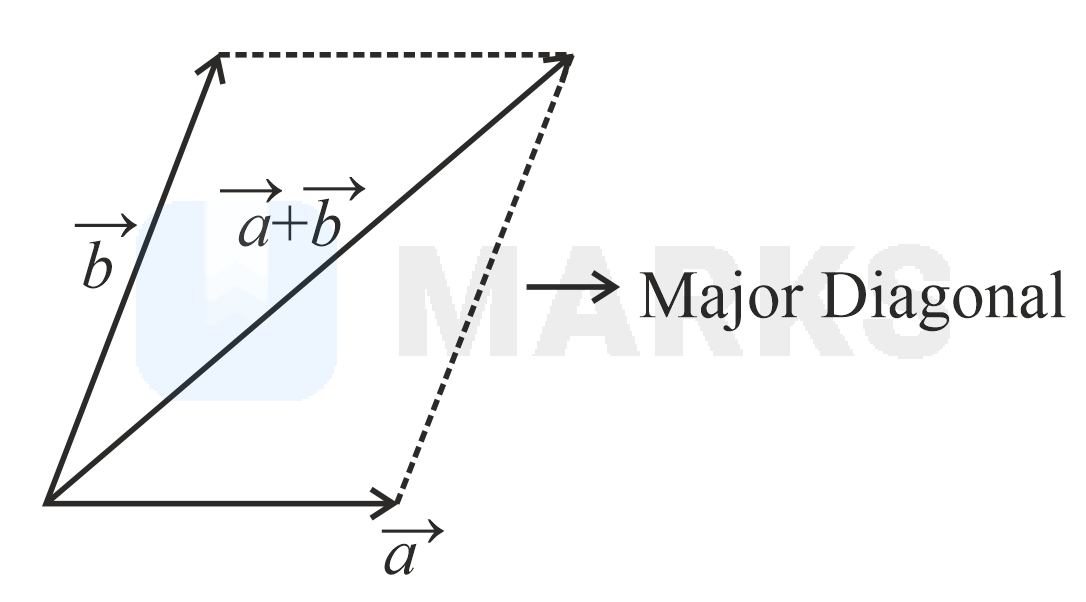
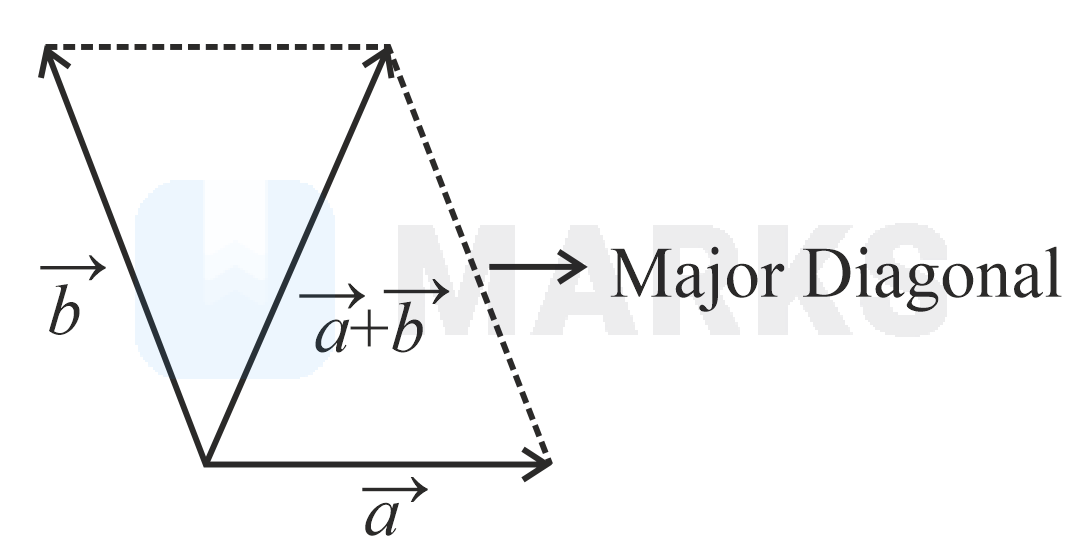
If represents side of parallelogram, then is represented by diagonal of parallelogram.
Case-, Angle between them is acute, then the addition is represented major diagonal shown as below,
Case-, Angle between them is obtuse, then the addition is represented minor diagonal shown as below,
major diagonal, if angle between vectors is acute.
minor diagonal, if angle between vectors is obtuse.
Looking for more such questions to practice?
Download the MARKS App - The ultimate prep app for IIT JEE & NEET with chapter-wise PYQs, revision notes, formula sheets, custom tests & much more.