Search any question & find its solution
Question:
Answered & Verified by Expert
If a plant shows a symptom which could develop due to deficiency of more than one nutrient, how would you find out experimentally, the real deficient mineral element?
Solution:
1828 Upvotes
Verified Answer
The deficiency symptoms can be distinguished on the basis of the region of occurrence, presence or absence of dead spots, and chlorosis of entire leaf or interveinal chlorosis.
The region of appearance of deficiency symptoms depends on mobility of nutrient in plants. The nutrient deficiency symptoms of $\mathrm{N}, \mathrm{P}, \mathrm{K}, \mathrm{Mg}$ and Mo appear in lower leaves. Zinc is moderately mobile in plants and deficiency symptoms, therefore, appear in middle leaves. The deficiency symptoms of less mobile elements ( $\mathrm{S}, \mathrm{Fe}$, $\mathrm{Mn}$ and $\mathrm{Cu}$ ) appear on new leaves.
- $\quad$ Ca and $\mathrm{B}$ are immobile in plants, deficiency symptoms appear on terminal buds.
- Chlorine deficiency is less common in crop.
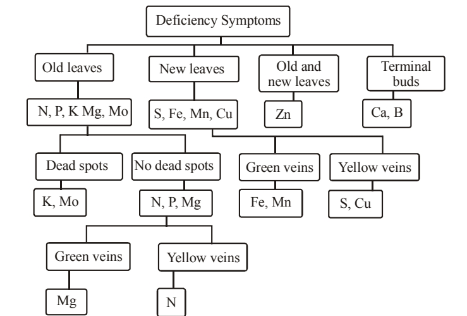
The region of appearance of deficiency symptoms depends on mobility of nutrient in plants. The nutrient deficiency symptoms of $\mathrm{N}, \mathrm{P}, \mathrm{K}, \mathrm{Mg}$ and Mo appear in lower leaves. Zinc is moderately mobile in plants and deficiency symptoms, therefore, appear in middle leaves. The deficiency symptoms of less mobile elements ( $\mathrm{S}, \mathrm{Fe}$, $\mathrm{Mn}$ and $\mathrm{Cu}$ ) appear on new leaves.
- $\quad$ Ca and $\mathrm{B}$ are immobile in plants, deficiency symptoms appear on terminal buds.
- Chlorine deficiency is less common in crop.
Looking for more such questions to practice?
Download the MARKS App - The ultimate prep app for IIT JEE & NEET with chapter-wise PYQs, revision notes, formula sheets, custom tests & much more.