Search any question & find its solution
Question:
Answered & Verified by Expert
If $f:[0,3] \rightarrow[0,3]$ is defined by $f(x)$ $=\left\{\begin{array}{ll}1+x, & 0 \leq x \leq 2 \\ 3-x, & 2 < x \leq 3\end{array}\right.$, then fof is
Options:
Solution:
1933 Upvotes
Verified Answer
The correct answer is:
Discontinuous at $x=1$ and $x=2$
$$
\begin{gathered}
g(x)=f(f(x))= \begin{cases}f(1+x) ; & 0 \leq x \leq 2 \\
f(3-x) & ; \quad 2 < x \leq 3\end{cases} \\
= \begin{cases}f(1+x) ; & 0 \leq x \leq 1 \\
f(1+x) ; & 1 \leq x \leq 2 \\
f(3-x) ; & 2 < x \leq 3\end{cases}
\end{gathered}
$$
$$
\begin{aligned}
& x \in[0,1] \Rightarrow(1+x) \in[1,2] \quad x \in[1,2] \Rightarrow(1+x) \in[2,3] \\
& x \in[2,3] \Rightarrow(3-x) \in[0,1]
\end{aligned}
$$
Hence,
$$
g(x)= \begin{cases}f(1+x) ; & \text { for } 0 \leq x \leq 1 \Rightarrow 1 \leq x+1 \leq 2 \\ f(1+x) ; & \text { for } 1 \leq x \leq 2 \Rightarrow 2 \leq x+1 \leq 3 \\ f(3-x) ; & \text { for } 2 < x \leq 3 \Rightarrow 0 \leq 3-x \leq 1\end{cases}
$$
Now, if $(1+x) \in[1,2]$ then,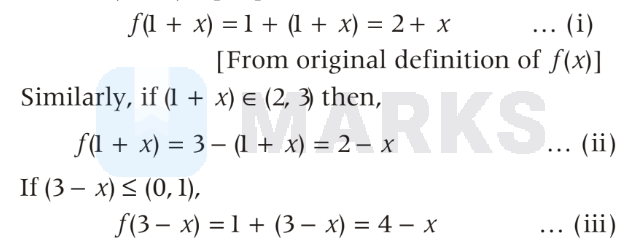
Using Eqs, (i), (ii), (iii), we get
$$
g(x)= \begin{cases}2+x & ; \quad 0 \leq x < 1 \\ 2-x ; & 1 < x \leq 2 \\ 4-x ; & 2 < x \leq 3\end{cases}
$$
Here, as $g(x)$ change the inequality sign at $x=1$ and $x=2$
Thus, to check continuity at $x=1$ and $x=2$ Now, we will check the continuity of $g(x)$ at
$$
\begin{aligned}
& x=1,2 \\
\text { At } x=1, \quad \text { LHL } & =\lim _{x \rightarrow 1^{-}} g(x)=\lim _{x \rightarrow 1^{-}}(2+x)=3 \\
\text { RHL } & =\lim _{x \rightarrow 1^{+}} g(x)=\lim _{x \rightarrow 1^{+}}(2-x)=1
\end{aligned}
$$
As. LHL $\neq$ RHL $g(x)$ is discontinuous at $x=1$.
$$
\begin{aligned}
\text { At } x=2 \quad \text { LHL } & =\lim _{x \rightarrow 2^{-}} g(x)=\lim _{x \rightarrow 2^{-}}(2-x)=0 \\
\text { RHL } & =\lim _{x \rightarrow 2^{+}} g(x)=\lim _{x \rightarrow 2^{+}}(4-x)=2
\end{aligned}
$$
As LHL $\neq$ RHL, $g(x)$ is discontinuous at $x=2$ Thus, $g(x)$ is continuous for all $x \in[0,1) \cup(1,2)$.
\begin{gathered}
g(x)=f(f(x))= \begin{cases}f(1+x) ; & 0 \leq x \leq 2 \\
f(3-x) & ; \quad 2 < x \leq 3\end{cases} \\
= \begin{cases}f(1+x) ; & 0 \leq x \leq 1 \\
f(1+x) ; & 1 \leq x \leq 2 \\
f(3-x) ; & 2 < x \leq 3\end{cases}
\end{gathered}
$$
$$
\begin{aligned}
& x \in[0,1] \Rightarrow(1+x) \in[1,2] \quad x \in[1,2] \Rightarrow(1+x) \in[2,3] \\
& x \in[2,3] \Rightarrow(3-x) \in[0,1]
\end{aligned}
$$
Hence,
$$
g(x)= \begin{cases}f(1+x) ; & \text { for } 0 \leq x \leq 1 \Rightarrow 1 \leq x+1 \leq 2 \\ f(1+x) ; & \text { for } 1 \leq x \leq 2 \Rightarrow 2 \leq x+1 \leq 3 \\ f(3-x) ; & \text { for } 2 < x \leq 3 \Rightarrow 0 \leq 3-x \leq 1\end{cases}
$$
Now, if $(1+x) \in[1,2]$ then,
Using Eqs, (i), (ii), (iii), we get
$$
g(x)= \begin{cases}2+x & ; \quad 0 \leq x < 1 \\ 2-x ; & 1 < x \leq 2 \\ 4-x ; & 2 < x \leq 3\end{cases}
$$
Here, as $g(x)$ change the inequality sign at $x=1$ and $x=2$
Thus, to check continuity at $x=1$ and $x=2$ Now, we will check the continuity of $g(x)$ at
$$
\begin{aligned}
& x=1,2 \\
\text { At } x=1, \quad \text { LHL } & =\lim _{x \rightarrow 1^{-}} g(x)=\lim _{x \rightarrow 1^{-}}(2+x)=3 \\
\text { RHL } & =\lim _{x \rightarrow 1^{+}} g(x)=\lim _{x \rightarrow 1^{+}}(2-x)=1
\end{aligned}
$$
As. LHL $\neq$ RHL $g(x)$ is discontinuous at $x=1$.
$$
\begin{aligned}
\text { At } x=2 \quad \text { LHL } & =\lim _{x \rightarrow 2^{-}} g(x)=\lim _{x \rightarrow 2^{-}}(2-x)=0 \\
\text { RHL } & =\lim _{x \rightarrow 2^{+}} g(x)=\lim _{x \rightarrow 2^{+}}(4-x)=2
\end{aligned}
$$
As LHL $\neq$ RHL, $g(x)$ is discontinuous at $x=2$ Thus, $g(x)$ is continuous for all $x \in[0,1) \cup(1,2)$.
Looking for more such questions to practice?
Download the MARKS App - The ultimate prep app for IIT JEE & NEET with chapter-wise PYQs, revision notes, formula sheets, custom tests & much more.