Search any question & find its solution
Question:
Answered & Verified by Expert
In a $\triangle A B C, r_1, r_2$ and $r_3$ respectively denote the radius of excircles opposite to the vertices $A$, $B, C$ and $r$ denotes the radius of the incircle. If $p_1, p_2$ and $p_3$ respectively are the altitudes of the triangle from the vertices $A, B$ and $C$, then $\left(\frac{1}{p_1}+\frac{1}{p_2}+\frac{1}{p_3}\right)^2$ is equal to
Options:
Solution:
1172 Upvotes
Verified Answer
The correct answer is:
$\frac{1}{r}\left(\frac{1}{r_1}+\frac{1}{r_2}+\frac{1}{r_3}\right)$
$\begin{aligned} & \Delta=\frac{1}{2} \cdot a \cdot p_1 \\ & \Rightarrow \quad p_1=\frac{2 \Delta}{a} \Rightarrow \frac{1}{p_1}=\frac{a}{2 \Delta} \\ & p_2=\frac{2 \Delta}{b} \Rightarrow \frac{1}{p_2}=\frac{b}{2 \Delta} \\ & p_3=\frac{2 \Delta}{c} \Rightarrow \frac{1}{p_3}=\frac{c}{2 \Delta}\end{aligned}$
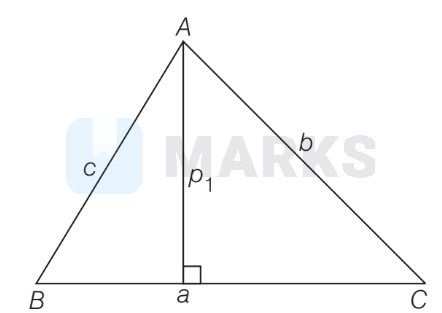
Now, $\begin{aligned}\left(\frac{1}{p_1}+\frac{1}{p_2}+\right. & \left.\frac{1}{p_3}\right)^2=\left(\frac{a}{2 \Delta}+\frac{b}{2 \Delta}+\frac{c}{2 \Delta}\right)^2 \\ & =\frac{(a+b+c)}{4 \Delta^2} \quad[\because a+b+c=2 s] \\ & =\frac{4 s^2}{4 \Delta^2}=\frac{s^2}{\Delta^2}=\frac{1}{r^2}=\frac{1}{r} \cdot\left(\frac{1}{r}\right) \\ & =\frac{1}{r}\left(\frac{1}{r_1}+\frac{1}{r_2}+\frac{1}{r_3}\right)\end{aligned}$
Now, $\begin{aligned}\left(\frac{1}{p_1}+\frac{1}{p_2}+\right. & \left.\frac{1}{p_3}\right)^2=\left(\frac{a}{2 \Delta}+\frac{b}{2 \Delta}+\frac{c}{2 \Delta}\right)^2 \\ & =\frac{(a+b+c)}{4 \Delta^2} \quad[\because a+b+c=2 s] \\ & =\frac{4 s^2}{4 \Delta^2}=\frac{s^2}{\Delta^2}=\frac{1}{r^2}=\frac{1}{r} \cdot\left(\frac{1}{r}\right) \\ & =\frac{1}{r}\left(\frac{1}{r_1}+\frac{1}{r_2}+\frac{1}{r_3}\right)\end{aligned}$
Looking for more such questions to practice?
Download the MARKS App - The ultimate prep app for IIT JEE & NEET with chapter-wise PYQs, revision notes, formula sheets, custom tests & much more.