Search any question & find its solution
Question:
Answered & Verified by Expert
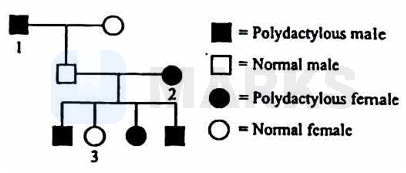
In humans, polydactyly (i.e. presence of extra fingers and toes) is determined by a dominant autosomal allele (P) and the normal condition is determined by a recessive allele (p). Find out the possible genotypes of family members 1, 2 and 3 in the given pedigree.
Options:
Solution:
1497 Upvotes
Verified Answer
The correct answer is:
Pedigree analysis provides information regarding inheritance of particular traits or diseases and using it we can predict the possibility of appearance of any traits in the new generation.
Member 3 is unaffected and the normal condition is recessive thus its genotype will be pp. To obtain recessive homozygous condition, both parents must have the recessive allele, therefore, member 2 must be heterozygous as it is affected one. Genotype of member 2 is Pp.
Member 1 genotype is also Pp as the son is unaffected (pp) and the wife of member 1 is normal.
Member 3 is unaffected and the normal condition is recessive thus its genotype will be pp. To obtain recessive homozygous condition, both parents must have the recessive allele, therefore, member 2 must be heterozygous as it is affected one. Genotype of member 2 is Pp.
Member 1 genotype is also Pp as the son is unaffected (pp) and the wife of member 1 is normal.
Looking for more such questions to practice?
Download the MARKS App - The ultimate prep app for IIT JEE & NEET with chapter-wise PYQs, revision notes, formula sheets, custom tests & much more.