Search any question & find its solution
Question:
Answered & Verified by Expert
Is there a species specific or region specific type of plastids? How does one distinguish one from the other?
Solution:
2024 Upvotes
Verified Answer
Plastids are specific to different species and are found in all plant cells and in euglenoids. They bear certain pigments that impart specific colours to the part of the plant possesing them. Plastids ar classified into three main types, based on the type of pigments- leucoplasts, chromoplast and chloroplast.
Leucoplasts are colourless plastids which store food material. They are of three types based on their storage products.
(a) Amyloplasts store starch, e.g., tuber of potato, grain of rice, grain of wheat.
(b) Elaioplasts store fats, e.g., rose
(c) Aleuroplasts are protein storing plastids, e.g., castor endosperm.
Chromoplast are non photosynthetic coloured plastids which synthesise and store carotenoid pigments. They appear orange, red or yellow. These mostly occur in ripe fruits (tomato and chilies) carrot roots, etc.
Chloroplasts are green color plastids which help in synthesising food material by photosyntheis. They contain chrophyll and carotenoid pigments which trap light energy. Each chloroplast is oval or spherical, double membrane bound cell organelle.
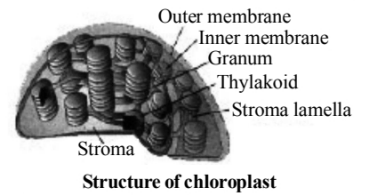
The space present inside inner membrane is called stroma. A number rof organised flattened membranous sacs called thylakoids are present in the stroma. Thylakoids are arranged in stacks called grana.
The thylakoids of different grana are connected by membranous tubules called the stroma lamellae. The stroma of the lamellae contain the enzymes that are required for the synthesis of carbohydrates and proteins.
Leucoplasts are colourless plastids which store food material. They are of three types based on their storage products.
(a) Amyloplasts store starch, e.g., tuber of potato, grain of rice, grain of wheat.
(b) Elaioplasts store fats, e.g., rose
(c) Aleuroplasts are protein storing plastids, e.g., castor endosperm.
Chromoplast are non photosynthetic coloured plastids which synthesise and store carotenoid pigments. They appear orange, red or yellow. These mostly occur in ripe fruits (tomato and chilies) carrot roots, etc.
Chloroplasts are green color plastids which help in synthesising food material by photosyntheis. They contain chrophyll and carotenoid pigments which trap light energy. Each chloroplast is oval or spherical, double membrane bound cell organelle.
The space present inside inner membrane is called stroma. A number rof organised flattened membranous sacs called thylakoids are present in the stroma. Thylakoids are arranged in stacks called grana.
The thylakoids of different grana are connected by membranous tubules called the stroma lamellae. The stroma of the lamellae contain the enzymes that are required for the synthesis of carbohydrates and proteins.
Looking for more such questions to practice?
Download the MARKS App - The ultimate prep app for IIT JEE & NEET with chapter-wise PYQs, revision notes, formula sheets, custom tests & much more.