Search any question & find its solution
Question:
Answered & Verified by Expert
Kirchhoff's law of junction, $\Sigma I=0$, is based on
Options:
Solution:
1815 Upvotes
Verified Answer
The correct answer is:
conservation of charge
Kirchhoff's first law states that in an electric circuit, the algebraic sum of the currents meeting at any junction in the circuit is zero.
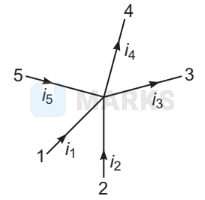
i.e., $\quad \Sigma i=0$
Hence, according to Kirchhoff's law
$i_1+i_2=i_3+i_4+i_5$
Thus, the sum of currents flowing towards the junction is equal to the sum of the currents flowing away from the junction. In other words, when a steady current flows in a circuit, then there is neither any accumulation of charge at any point in the circuit, nor any charge is removed from there. Thus, Kirchhoff's first law expresses the conservation of charge.
i.e., $\quad \Sigma i=0$
Hence, according to Kirchhoff's law
$i_1+i_2=i_3+i_4+i_5$
Thus, the sum of currents flowing towards the junction is equal to the sum of the currents flowing away from the junction. In other words, when a steady current flows in a circuit, then there is neither any accumulation of charge at any point in the circuit, nor any charge is removed from there. Thus, Kirchhoff's first law expresses the conservation of charge.
Looking for more such questions to practice?
Download the MARKS App - The ultimate prep app for IIT JEE & NEET with chapter-wise PYQs, revision notes, formula sheets, custom tests & much more.