Search any question & find its solution
Question:
Answered & Verified by Expert
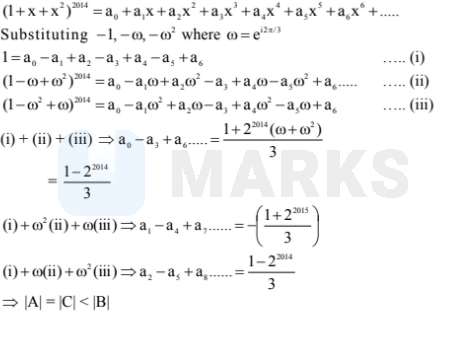
Let $\left(1+x+x^{2}\right)^{2014}=a_{0}+a_{1} x+a_{2} x^{2}+a_{3} x^{3}+\ldots . .+a_{s+28} x^{4028}$ and let
$$
\begin{array}{l}
A=a_{0}-a_{3}+a_{6}-\ldots \ldots+a_{4026} \\
B=a_{1}-a_{4}+a_{7}-\ldots \ldots .-a_{4027} \\
C=a_{2}-a_{5}+a_{8}-\ldots \ldots .+a_{4028}
\end{array}
$$
Then
Options:
$$
\begin{array}{l}
A=a_{0}-a_{3}+a_{6}-\ldots \ldots+a_{4026} \\
B=a_{1}-a_{4}+a_{7}-\ldots \ldots .-a_{4027} \\
C=a_{2}-a_{5}+a_{8}-\ldots \ldots .+a_{4028}
\end{array}
$$
Then
Solution:
1504 Upvotes
Verified Answer
The correct answer is:
$|A|=|C|>|B|$
Looking for more such questions to practice?
Download the MARKS App - The ultimate prep app for IIT JEE & NEET with chapter-wise PYQs, revision notes, formula sheets, custom tests & much more.