Search any question & find its solution
Question:
Answered & Verified by Expert
Let $n \geq 3$ and let $C_{1}, C_{2}, \ldots . C_{n}$, be circles with radii $r_{1}, r_{2}, \ldots, r_{n}$, respectively. Assume that $C_{i}$ and $C_{i+1}$ touch externally for $1 \leq i \leq n-1$. It is also given that the $x$-axis and the line $y=2 \sqrt{2} x+10$ are tangential to each of the circles. Then $r_{1}, r_{2}, \ldots \ldots, r_{n}$ are in
Options:
Solution:
2033 Upvotes
Verified Answer
The correct answer is:
Ageometric progression with common ratio $2+\sqrt{3}$
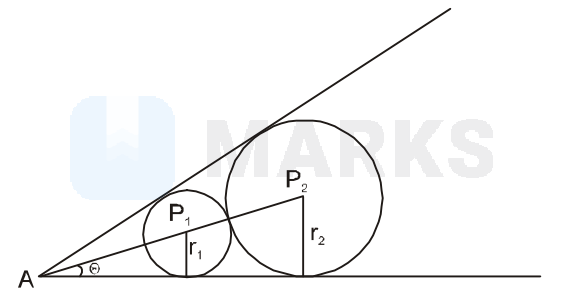
$\operatorname{Sin} \theta=\frac{1}{\sqrt{3}}=\frac{r_{1}}{\mathrm{AP}_{1}}=\frac{r_{2}}{\mathrm{AP}_{2}}$
$\mathrm{AP}_{2}=\mathrm{AP}_{1}+\mathrm{r}_{1}+\mathrm{r}_{2}$
$\mathrm{r}_{2} \sqrt{3}=\mathrm{r}_{1} \sqrt{3}+\mathrm{r}_{1}+\mathrm{r}_{2}$
$\mathrm{r}_{2}(\sqrt{3}-1)=\mathrm{r}_{1}(\sqrt{3}+1)$
$\frac{r_{2}}{r_{1}}=2+\sqrt{3}$
Looking for more such questions to practice?
Download the MARKS App - The ultimate prep app for IIT JEE & NEET with chapter-wise PYQs, revision notes, formula sheets, custom tests & much more.