Search any question & find its solution
Question:
Answered & Verified by Expert
Let the electrostatic field $\mathrm{E}$ at distance $\mathrm{r}$ from a point charge $q$ not be an inverse square but, instead an inverse cubic, e.g. $\overrightarrow{\mathrm{E}}=\mathrm{k} \frac{\mathrm{q}}{\mathrm{r}^{3}} \hat{\mathrm{r}}$
Here $\mathrm{k}$ is a constant. Consider the following two statements
(i) Flux through a spherical surface enclosing the charge is $\phi=q_{\text {enclosed }} / \in_{0}$
(ii) A charge placed inside uniformly charged shell will experience a force.
Choose the correct option.
Options:
Here $\mathrm{k}$ is a constant. Consider the following two statements
(i) Flux through a spherical surface enclosing the charge is $\phi=q_{\text {enclosed }} / \in_{0}$
(ii) A charge placed inside uniformly charged shell will experience a force.
Choose the correct option.
Solution:
2507 Upvotes
Verified Answer
The correct answer is:
Only (ii) is valid
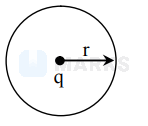
$|\overrightarrow{\mathrm{E}}|=\frac{\mathrm{kq}}{\mathrm{r}^{3}}$
$\therefore \mathrm{d} \phi=\overrightarrow{\mathrm{E}} \cdot \overrightarrow{\mathrm{dS}}$
$\phi=\int \mathrm{d} \phi=\int \overrightarrow{\mathrm{E}} \overrightarrow{\mathrm{dS}}=\frac{\mathrm{kq}}{\mathrm{r}^{3}} \cdot 4 \pi \mathrm{r}^{2}$
$\phi=\frac{\mathrm{kq} 4 \pi}{\mathrm{r}} \neq \frac{\mathrm{q}_{\mathrm{en}}}{\varepsilon_{0}}$
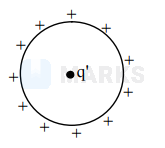
force on $q^{\prime}$ is zero
Looking for more such questions to practice?
Download the MARKS App - The ultimate prep app for IIT JEE & NEET with chapter-wise PYQs, revision notes, formula sheets, custom tests & much more.