Search any question & find its solution
Question:
Answered & Verified by Expert
Let the vectors $\mathbf{P Q}, \mathbf{Q R}, \mathbf{R S}, \mathbf{S T}, \mathbf{T U}$ and UP represent the sides of a regular hexagon.
Statement I PQ $\times(\mathbf{R S}+\mathbf{S T}) \neq \mathbf{0}$
Statement II $\mathbf{P Q} \times \mathbf{R S}=\mathbf{0}$ and $\mathbf{P Q} \times \mathbf{S Q} \neq \mathbf{0}$
Options:
Statement I PQ $\times(\mathbf{R S}+\mathbf{S T}) \neq \mathbf{0}$
Statement II $\mathbf{P Q} \times \mathbf{R S}=\mathbf{0}$ and $\mathbf{P Q} \times \mathbf{S Q} \neq \mathbf{0}$
Solution:
2297 Upvotes
Verified Answer
The correct answer is:
Statement I is true, Statement II is false
Statement I is true, Statement II is false
Since, $\mathbf{P Q}$ is not parallel to $\mathbf{T R}$
$\because$ TR is resultant of $\mathbf{S R}$ and $\mathbf{S T}$ vectors.
$\Rightarrow \quad \mathbf{P Q} \times(\mathbf{R S}+\mathbf{S T}) \neq \mathbf{0}$
But for Statement II, we have $\mathbf{P Q} \times \mathbf{R S}=\mathbf{0}$
which is not possible as $\mathbf{P Q}$ not parallel to $\mathbf{R S}$.
Hence, Statement I is true and Statement II is false.
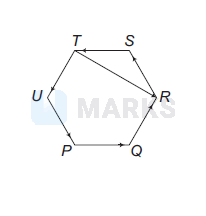
$\because$ TR is resultant of $\mathbf{S R}$ and $\mathbf{S T}$ vectors.
$\Rightarrow \quad \mathbf{P Q} \times(\mathbf{R S}+\mathbf{S T}) \neq \mathbf{0}$
But for Statement II, we have $\mathbf{P Q} \times \mathbf{R S}=\mathbf{0}$
which is not possible as $\mathbf{P Q}$ not parallel to $\mathbf{R S}$.
Hence, Statement I is true and Statement II is false.
Looking for more such questions to practice?
Download the MARKS App - The ultimate prep app for IIT JEE & NEET with chapter-wise PYQs, revision notes, formula sheets, custom tests & much more.