Search any question & find its solution
Question:
Answered & Verified by Expert
Light of two different frequencies whose photons have energies $1 \mathrm{eV}$ and $2.5 \mathrm{eV}$ respectively, successively illuminate a metallic surface whose work function is $0.5 \mathrm{eV}$. Ratio of maximum speeds of emitted electrons will be
Options:
Solution:
2019 Upvotes
Verified Answer
The correct answer is:
$1: 2$
According to Einstein's photoelectric equation, the maximum kinetic energy of emitted photoelectrons is
$K_{\max }=h v-\phi_0$
where $h v$ is the energy of incident photon and $\phi_0$ is the work function.
But $K_{\max }=\frac{1}{2} m v_{\max }^2$
$\therefore \quad \frac{1}{2} m v_{\max }^2=h v-\phi_0$
As per question,
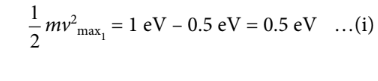

Dividing eqn. (i) by eqn. (ii), we get
$\begin{aligned} & \frac{v_{\max _1}^2}{v_{\max _2}^2}=\frac{0.5 \mathrm{eV}}{2 \mathrm{eV}}=\frac{1}{4} \\ & \frac{v_{\max _1}}{v_{\max _2}}=\sqrt{\frac{1}{4}}=\frac{1}{2}\end{aligned}$
$K_{\max }=h v-\phi_0$
where $h v$ is the energy of incident photon and $\phi_0$ is the work function.
But $K_{\max }=\frac{1}{2} m v_{\max }^2$
$\therefore \quad \frac{1}{2} m v_{\max }^2=h v-\phi_0$
As per question,
Dividing eqn. (i) by eqn. (ii), we get
$\begin{aligned} & \frac{v_{\max _1}^2}{v_{\max _2}^2}=\frac{0.5 \mathrm{eV}}{2 \mathrm{eV}}=\frac{1}{4} \\ & \frac{v_{\max _1}}{v_{\max _2}}=\sqrt{\frac{1}{4}}=\frac{1}{2}\end{aligned}$
Looking for more such questions to practice?
Download the MARKS App - The ultimate prep app for IIT JEE & NEET with chapter-wise PYQs, revision notes, formula sheets, custom tests & much more.