Search any question & find its solution
Question:
Answered & Verified by Expert
List I describes four systems, each with two particles and in relative motion as shown in figure. List II gives possible magnitudes of their relative velocities (in ) at time .
| List-I | List-II | ||
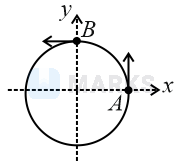
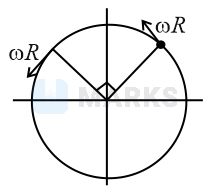
| (I) | and are moving on a horizontal circle of radius with uniform angular speed . The initial angular positions of and at time are and respectively.
| (P) | |
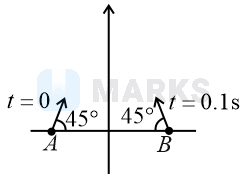
| (II) | Projectiles and are fired (in the same vertical plane) at and respectively, with the same speed and at from the horizontal plane. The initial separation between and is large enough so that they do not collide, .
| (Q) | |
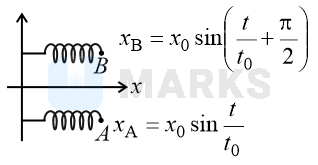
| (III) | Two harmonic oscillators and moving in the direction according to and respectively, starting from . Take .
| (R) | |
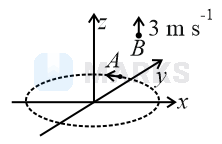
| (IV) | Particle is rotating in a horizontal circular path of radius on the plane, with constant angular speed . Particle is moving up at a constant speed in the vertical direction as shown in the figure. (Ignore gravity.)
| (S) | |
| (T) |
Which one of the following options is correct?
Solution:
1854 Upvotes
Verified Answer
The correct answer is:
(I)
Angular velocity of both the particles is same. Therefore, angle between them will remain .
Hence,
(II)
The velocity of A at any time t can be written as
Velocity of B at any time t
Relative velocity at time t will be,
Hence,
(III)
Relative position of A wrt B can be written as
Using trigonometric relation
Therefore,
at
Hence,
(IV)
The velocity of A is in plane and it is and the velocity of B is along axis and . Therefore,
Hence,
Looking for more such questions to practice?
Download the MARKS App - The ultimate prep app for IIT JEE & NEET with chapter-wise PYQs, revision notes, formula sheets, custom tests & much more.