Search any question & find its solution
Question:
Answered & Verified by Expert
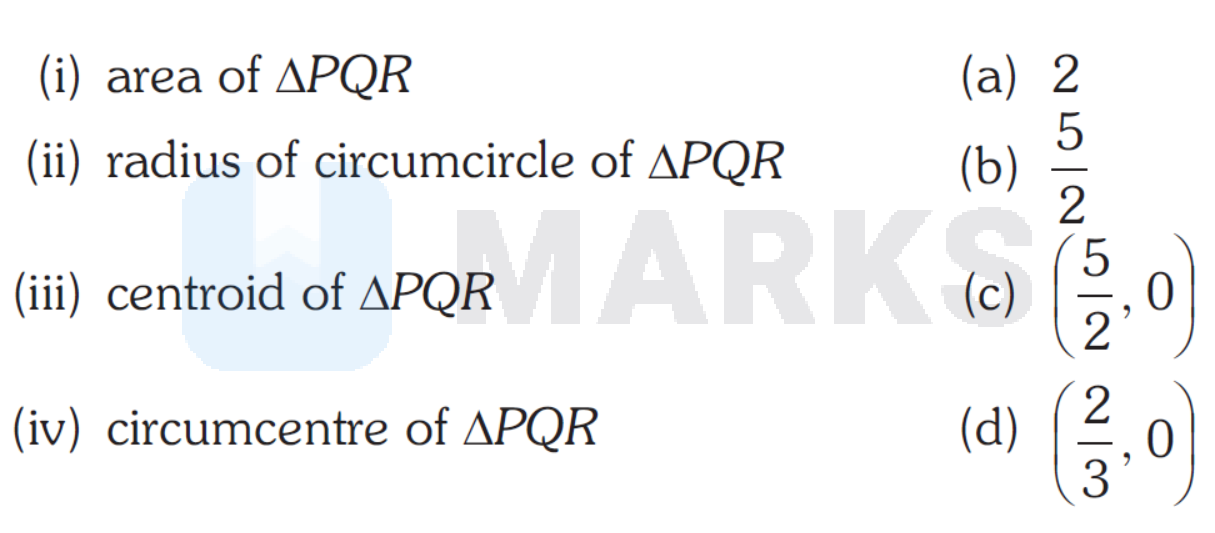
Match the column.
Normals at $P, Q, R$ are drawn to $y^2=4 x$ which intersect at $(3,0)$. Then,
Options:
Normals at $P, Q, R$ are drawn to $y^2=4 x$ which intersect at $(3,0)$. Then,
Solution:
1999 Upvotes
Verified Answer
The correct answer is:
(i) (a), (ii) (b), (iii) (d), (iv) (c)
(i) (a), (ii) (b), (iii) (d), (iv) (c)
Since, equation of normal is $y+x t=2 a t+a t^3$ passes through $(3,0)$.
$$
\Rightarrow \quad 3 t=2 t+t^3 \Rightarrow t=0,1,-1 \text {. }
$$
$\therefore P(1,2), Q(0,0), R(1,-2)$. Thus,
(i) Area of $\triangle P Q R=\frac{1}{2} \times 1 \times 4=2$
(ii) Centroid of $\triangle P Q R=\left(\frac{2}{3}, 0\right)$
Equation of circle passing through $P, Q, R$ is
$$
\begin{aligned}
& \quad(x-1)(x-1)+(y-2)(y+2)+\lambda(x-1)=0 \\
& \Rightarrow \quad 1-4-\lambda=0 \Rightarrow \lambda=-3 \\
& \therefore \text { Required equation of circle is } x^2+y^2-5 x-1=0 \\
& \therefore \text { Centre }\left(\frac{5}{2}, 0\right) \text { and radius } \frac{5}{2} .
\end{aligned}
$$
$$
\Rightarrow \quad 3 t=2 t+t^3 \Rightarrow t=0,1,-1 \text {. }
$$
$\therefore P(1,2), Q(0,0), R(1,-2)$. Thus,
(i) Area of $\triangle P Q R=\frac{1}{2} \times 1 \times 4=2$
(ii) Centroid of $\triangle P Q R=\left(\frac{2}{3}, 0\right)$
Equation of circle passing through $P, Q, R$ is
$$
\begin{aligned}
& \quad(x-1)(x-1)+(y-2)(y+2)+\lambda(x-1)=0 \\
& \Rightarrow \quad 1-4-\lambda=0 \Rightarrow \lambda=-3 \\
& \therefore \text { Required equation of circle is } x^2+y^2-5 x-1=0 \\
& \therefore \text { Centre }\left(\frac{5}{2}, 0\right) \text { and radius } \frac{5}{2} .
\end{aligned}
$$
Looking for more such questions to practice?
Download the MARKS App - The ultimate prep app for IIT JEE & NEET with chapter-wise PYQs, revision notes, formula sheets, custom tests & much more.