Search any question & find its solution
Question:
Answered & Verified by Expert
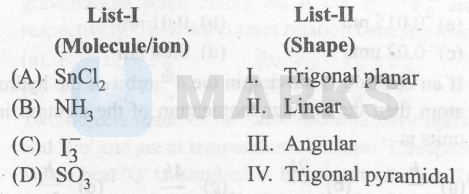
Match the following
The correct answer is
Options:
The correct answer is
Solution:
1081 Upvotes
Verified Answer
The correct answer is:
A-III, B-IV, C-II, D-I
Sn belongs to group 14 and has four valence electrons out of which two are used for forming two
$\mathrm{Sn}-\mathrm{Cl}$ bonds and the remaining two form a lone pair of electrons.
Thus, $\mathrm{SnCl}_2$ will be angular or bent in shape. $\mathrm{NH}_3$ has three bond pairs and one lone pair so it acquires a trigonal pyramidal shape.
$\mathrm{I}_3{ }^{-}$has a linear geometry as the two bond pairs lie along a straight line while the three lone pairs form the equatorial geometry. $\mathrm{SO}_3$ has three bond pairs only so it forms a trigonal planar shape.
Thus, $\mathrm{A} \rightarrow \mathrm{III}, \mathrm{B} \rightarrow \mathrm{IV}, \mathrm{C} \rightarrow \mathrm{II}, \mathrm{D} \rightarrow \mathrm{I}$.
$\mathrm{Sn}-\mathrm{Cl}$ bonds and the remaining two form a lone pair of electrons.
Thus, $\mathrm{SnCl}_2$ will be angular or bent in shape. $\mathrm{NH}_3$ has three bond pairs and one lone pair so it acquires a trigonal pyramidal shape.
$\mathrm{I}_3{ }^{-}$has a linear geometry as the two bond pairs lie along a straight line while the three lone pairs form the equatorial geometry. $\mathrm{SO}_3$ has three bond pairs only so it forms a trigonal planar shape.
Thus, $\mathrm{A} \rightarrow \mathrm{III}, \mathrm{B} \rightarrow \mathrm{IV}, \mathrm{C} \rightarrow \mathrm{II}, \mathrm{D} \rightarrow \mathrm{I}$.
Looking for more such questions to practice?
Download the MARKS App - The ultimate prep app for IIT JEE & NEET with chapter-wise PYQs, revision notes, formula sheets, custom tests & much more.