Search any question & find its solution
Question:
Answered & Verified by Expert
Show that the semi-vertical angle of the cone of the maximum volume and of given slant height is $\tan ^{-1} \sqrt{2}$.
Solution:
2164 Upvotes
Verified Answer
Let $v$ be the volume, $\ell$ be the slant height and $\theta$ be the semi vertical angle of a cone.
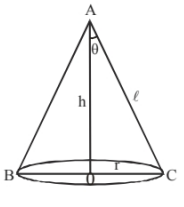
$\mathrm{v}=\frac{1}{3} \pi \mathrm{r}^2 \mathrm{~h}$, Vertical height
$\mathrm{h}=\ell \cos \theta$
and radius $=\ell \sin \theta$
$\therefore \mathrm{v}=\frac{1}{3} \pi(\ell \sin \theta)^2(\ell \cos \theta)$
$\frac{\mathrm{dv}}{\mathrm{d} \theta}=\frac{1}{3} \pi \ell^3 \sin \theta\left(2 \cos ^2 \theta-\sin ^2 \theta\right)$
$=0$ at $\tan \theta=\sqrt{2} \quad(\because \sin \theta \neq 0)$ $\frac{\mathrm{dv}}{\mathrm{d} \theta}=-\frac{1}{3} \pi \ell^3 \sin \theta \cos ^2 \theta(\tan \theta-\sqrt{2})(\tan \theta+\sqrt{2})$
When $\theta$ is slightly $ < \tan ^{-1} \sqrt{2} ; \sin \theta \cos ^2 \theta=+$ ve, $\tan \theta-\sqrt{2}=-v e ; \tan \theta+\sqrt{2}=+v e$
$\therefore \frac{\mathrm{dv}}{\mathrm{d} \theta}=+\mathrm{ve}$
when $\theta$ is slightly $>\tan ^{-1} \sqrt{2}$
$\sin \theta \cos ^2 \theta=+v e, \tan \theta-\sqrt{2}=+v e$ $\tan \theta+\sqrt{2}=+$ ve, $\quad \therefore \frac{\mathrm{dv}}{\mathrm{d} \theta}=(-)(+)(+)(+)=-\mathrm{ve}$
$\therefore \frac{\mathrm{dv}}{\mathrm{d} \theta}$ changes sign $+$ ve to $-\mathrm{ve}$
$\therefore \mathrm{v}$ is maximum at $\theta=\tan ^{-1} \sqrt{2}$.
$\mathrm{v}=\frac{1}{3} \pi \mathrm{r}^2 \mathrm{~h}$, Vertical height
$\mathrm{h}=\ell \cos \theta$
and radius $=\ell \sin \theta$
$\therefore \mathrm{v}=\frac{1}{3} \pi(\ell \sin \theta)^2(\ell \cos \theta)$
$\frac{\mathrm{dv}}{\mathrm{d} \theta}=\frac{1}{3} \pi \ell^3 \sin \theta\left(2 \cos ^2 \theta-\sin ^2 \theta\right)$
$=0$ at $\tan \theta=\sqrt{2} \quad(\because \sin \theta \neq 0)$ $\frac{\mathrm{dv}}{\mathrm{d} \theta}=-\frac{1}{3} \pi \ell^3 \sin \theta \cos ^2 \theta(\tan \theta-\sqrt{2})(\tan \theta+\sqrt{2})$
When $\theta$ is slightly $ < \tan ^{-1} \sqrt{2} ; \sin \theta \cos ^2 \theta=+$ ve, $\tan \theta-\sqrt{2}=-v e ; \tan \theta+\sqrt{2}=+v e$
$\therefore \frac{\mathrm{dv}}{\mathrm{d} \theta}=+\mathrm{ve}$
when $\theta$ is slightly $>\tan ^{-1} \sqrt{2}$
$\sin \theta \cos ^2 \theta=+v e, \tan \theta-\sqrt{2}=+v e$ $\tan \theta+\sqrt{2}=+$ ve, $\quad \therefore \frac{\mathrm{dv}}{\mathrm{d} \theta}=(-)(+)(+)(+)=-\mathrm{ve}$
$\therefore \frac{\mathrm{dv}}{\mathrm{d} \theta}$ changes sign $+$ ve to $-\mathrm{ve}$
$\therefore \mathrm{v}$ is maximum at $\theta=\tan ^{-1} \sqrt{2}$.
Looking for more such questions to practice?
Download the MARKS App - The ultimate prep app for IIT JEE & NEET with chapter-wise PYQs, revision notes, formula sheets, custom tests & much more.