Search any question & find its solution
Question:
Answered & Verified by Expert
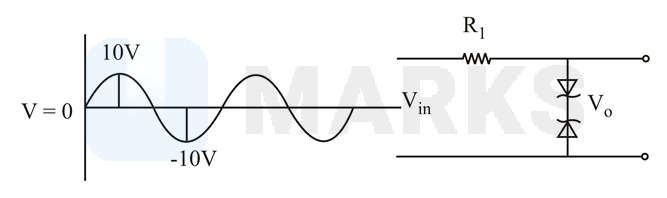
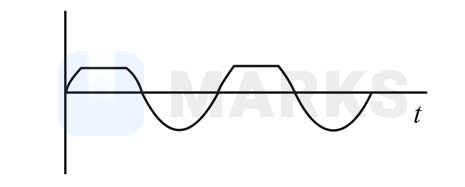
Take the breakdown voltage of the zener diode used in the given circuit as . For the input voltage shown in the figure below, the time variation of the output voltage is: (Graphs drawn are schematic and not to the scale)
- A
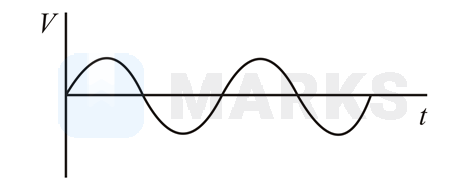
- B
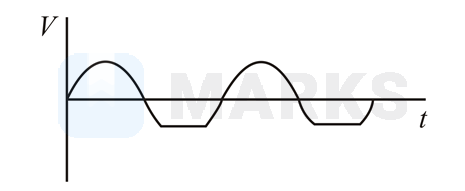
- C
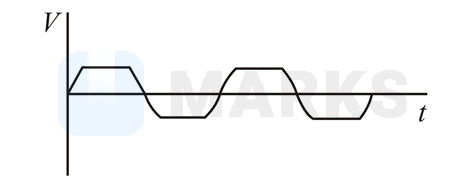
- D
Solution:
2529 Upvotes
Verified Answer
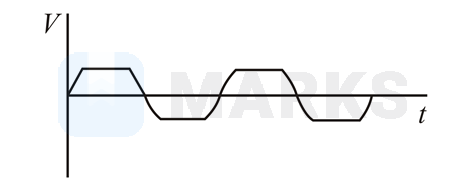
The correct answer is:
A diode in forward biased acts as short circuit, since current can smoothly pass in such case. The potential difference across this is negligible.
In reverse biased, initially, a negligible current can pass through it. When a voltage greater than the breakdown voltage applied across this, the potential difference remains at the breakdown voltage.
In this question, two diodes are connected in opposite polarity. At a time, one diode is in forward biased and other is reversed biased. For solution, we can ignore the forward-biased diode as its voltage is negligible. If the applied potential difference(input) across the reversed biased diode becomes greater than the breakdown voltage, the potential difference across it will not increase and maintains at breakdown voltage.
In this question, the potential difference is changing direction and there will be one diode in reverse biased always. Hence, every peak will have a cut section and the range of the output graph will be .
Looking for more such questions to practice?
Download the MARKS App - The ultimate prep app for IIT JEE & NEET with chapter-wise PYQs, revision notes, formula sheets, custom tests & much more.