Search any question & find its solution
Question:
Answered & Verified by Expert
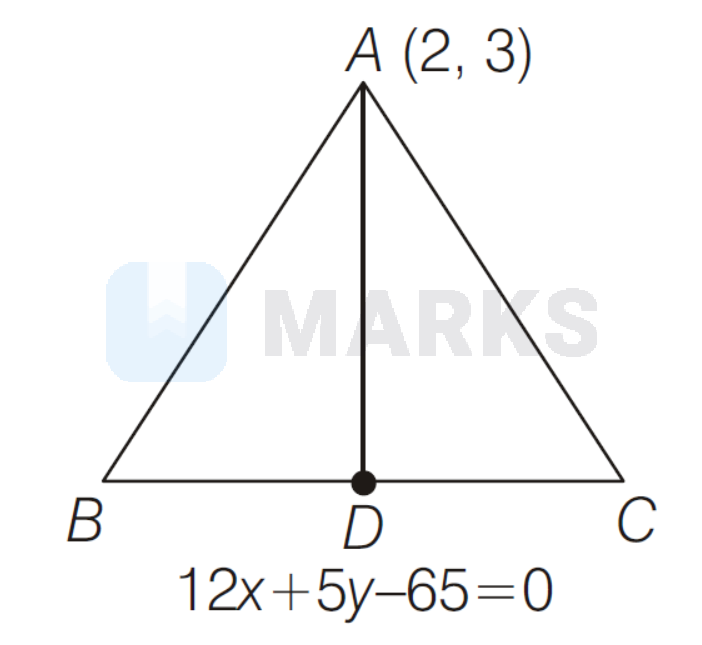
The equation of the base of an equilateral triangle is $12 x+5 y-65=0$. If one of its vertices is $(2,3)$, then the length of the side is
Options:
Solution:
2620 Upvotes
Verified Answer
The correct answer is:
$\frac{4}{\sqrt{3}}$
Since, $A(2,3)$ do not lie on $12 x+5 y-65=0$ $\therefore A D$ is altitude of $\triangle A B C$.
$$
\begin{aligned}
\therefore \text { Length of } A D & =\left|\frac{12 \times 2+5 \times 3-65}{\sqrt{12^2+5^2}}\right| \\
& =\left|\frac{24+15-65}{13}\right|=\left|\frac{26}{13}\right|=2
\end{aligned}
$$
We know that
Length of altitude $=\frac{\sqrt{3}}{2} \times$ side
$$
\therefore \text { Side }=\frac{2}{\sqrt{3}} \times A D=\frac{2}{\sqrt{3}} \times 2=\frac{4}{\sqrt{3}}
$$
$$
\begin{aligned}
\therefore \text { Length of } A D & =\left|\frac{12 \times 2+5 \times 3-65}{\sqrt{12^2+5^2}}\right| \\
& =\left|\frac{24+15-65}{13}\right|=\left|\frac{26}{13}\right|=2
\end{aligned}
$$
We know that
Length of altitude $=\frac{\sqrt{3}}{2} \times$ side
$$
\therefore \text { Side }=\frac{2}{\sqrt{3}} \times A D=\frac{2}{\sqrt{3}} \times 2=\frac{4}{\sqrt{3}}
$$
Looking for more such questions to practice?
Download the MARKS App - The ultimate prep app for IIT JEE & NEET with chapter-wise PYQs, revision notes, formula sheets, custom tests & much more.