Search any question & find its solution
Question:
Answered & Verified by Expert
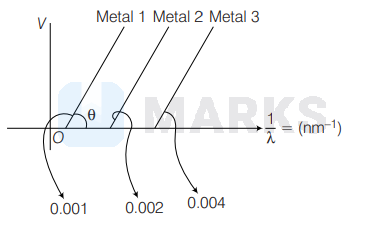
The graph $\frac{1}{\lambda}$ and stopping potential $(V)$ of three metals having work function $\phi_1, \phi_2$ and $\phi_3$ in an experiment of photoelectric effect is plotted as shown in the figure. Which one of the following statement is/are correct? [Here $\lambda$ is the wavelength of the incident ray]
(i) Ratio of work functions $\phi_1: \phi_2: \phi_3=1: 2: 4$
(ii) Ratio of work functions $\phi_1: \phi_2: \phi_3=4: 2: 1$
(iii) $\tan \theta \propto \frac{h c}{e}$, where $h=$ Planck's constant, $c=$ speed of light
(iv) The violet colour-light can eject photoelectrons from metals 2 and 3
Options:
(i) Ratio of work functions $\phi_1: \phi_2: \phi_3=1: 2: 4$
(ii) Ratio of work functions $\phi_1: \phi_2: \phi_3=4: 2: 1$
(iii) $\tan \theta \propto \frac{h c}{e}$, where $h=$ Planck's constant, $c=$ speed of light
(iv) The violet colour-light can eject photoelectrons from metals 2 and 3
Solution:
2229 Upvotes
Verified Answer
The correct answer is:
(i), (iii)
According to Einstein photoelectric equation,
$\begin{aligned} E & =K_{\max }+\phi \\ \therefore \quad \frac{h c}{\lambda} & =\phi+e V_S \\ \therefore \quad V_S & =\left[\frac{h c}{\lambda}-\phi\right] \frac{1}{e}\end{aligned}$
$V_S$ versus $\frac{1}{\lambda}$ graph is a straight line.
Slope,
$\tan \theta=\frac{h c}{e}$
The curves intersect the $\frac{1}{\lambda}$ axis, where $V_S$ is zero.
$\begin{aligned} \therefore & \frac{h c}{\lambda}-\phi & =0 \\ \Rightarrow & \frac{1}{\lambda} & =\frac{\phi}{h c}\end{aligned}$
For metal $1 \quad$ For metal 2 For metal 3
$\begin{array}{cc} & \frac{\phi_1}{h c}=0.001 \quad \frac{\phi_2}{h c}=0.002 \quad \frac{\phi_3}{h c}=0.004 \\ \therefore \quad & \phi_1: \phi_2: \phi_3=1: 2: 4\end{array}$
For metal 2, threshold wavelength,
$\lambda \mathrm{O}_2=\frac{h c}{\phi}=\frac{1}{0.002}=500 \mathrm{~nm}$
Similarly, $\quad \lambda \mathrm{o}_3=250 \mathrm{~nm}$
$\lambda_{\text {violet }}=400 \mathrm{~nm}$ So $\lambda_{\text {violet }} \lt \lambda_{\text {threshold }}$ for metal 1 ,
$\lambda_{\text {violet }}^{\text {violet }}\gt\lambda_{\text {threshold }}$ for metal 3
Thus, violet light will eject photoelectron for metal 2 and not metal 3 .
$\begin{aligned} E & =K_{\max }+\phi \\ \therefore \quad \frac{h c}{\lambda} & =\phi+e V_S \\ \therefore \quad V_S & =\left[\frac{h c}{\lambda}-\phi\right] \frac{1}{e}\end{aligned}$
$V_S$ versus $\frac{1}{\lambda}$ graph is a straight line.
Slope,
$\tan \theta=\frac{h c}{e}$
The curves intersect the $\frac{1}{\lambda}$ axis, where $V_S$ is zero.
$\begin{aligned} \therefore & \frac{h c}{\lambda}-\phi & =0 \\ \Rightarrow & \frac{1}{\lambda} & =\frac{\phi}{h c}\end{aligned}$
For metal $1 \quad$ For metal 2 For metal 3
$\begin{array}{cc} & \frac{\phi_1}{h c}=0.001 \quad \frac{\phi_2}{h c}=0.002 \quad \frac{\phi_3}{h c}=0.004 \\ \therefore \quad & \phi_1: \phi_2: \phi_3=1: 2: 4\end{array}$
For metal 2, threshold wavelength,
$\lambda \mathrm{O}_2=\frac{h c}{\phi}=\frac{1}{0.002}=500 \mathrm{~nm}$
Similarly, $\quad \lambda \mathrm{o}_3=250 \mathrm{~nm}$
$\lambda_{\text {violet }}=400 \mathrm{~nm}$ So $\lambda_{\text {violet }} \lt \lambda_{\text {threshold }}$ for metal 1 ,
$\lambda_{\text {violet }}^{\text {violet }}\gt\lambda_{\text {threshold }}$ for metal 3
Thus, violet light will eject photoelectron for metal 2 and not metal 3 .
Looking for more such questions to practice?
Download the MARKS App - The ultimate prep app for IIT JEE & NEET with chapter-wise PYQs, revision notes, formula sheets, custom tests & much more.