Search any question & find its solution
Question:
Answered & Verified by Expert
The length of a potentiometer wires is l. A cell of emf \(E\) is balanced at a length \(\left(\frac{l}{3}\right)\) from positive end of the wire. If the length of the wire is increased by \(\left(\frac{l}{2}\right)\), the distance at which the same cell gives the balancing point is
(Cell in the primary is ideal and no series resistance is present in the primary circuit.)
Options:
(Cell in the primary is ideal and no series resistance is present in the primary circuit.)
Solution:
2961 Upvotes
Verified Answer
The correct answer is:
\(\frac{I}{2}\)
According to question, the figure is as
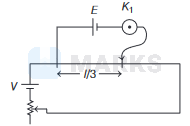
If \(K\) be the potential gradient of the potentiometer wire, then emf of the cell which gives balancing length \(\frac{l}{3}\) is given by
\(E=K \cdot \frac{l}{3}\)...(i)
Where, \(\quad E=\frac{V}{l} \cdot \frac{l}{3}=\frac{V}{3} \ldots\) (ii) \(\left[\because K=\frac{V}{l}\right]\)
When, length of potentiometer wire is increased by \(\frac{l}{2}\), then new length.
\(l_1=l+\frac{l}{2}=\frac{3 l}{2}\)
\(\therefore\) New potential gradient,
\(K^{\prime}=\frac{V}{\frac{3 l}{2}} \Rightarrow K^{\prime}=\frac{2 V}{3 l}\)
If \(l^{\prime}\) be the new balancing length,
\(\begin{gathered}
\text{then, } E=K^{\prime} l^{\prime} \quad \ldots (iii) \\
\text{or } E=\frac{2 V}{3 l} l^{\prime} \\
\frac{2 V}{3 l} \cdot l^{\prime}=\frac{V}{3} \Rightarrow l^{\prime}=\frac{l}{2} \quad\left[\text { From Eq. (iiii) } E=\frac{V}{3}\right]
\end{gathered}\)
If \(K\) be the potential gradient of the potentiometer wire, then emf of the cell which gives balancing length \(\frac{l}{3}\) is given by
\(E=K \cdot \frac{l}{3}\)...(i)
Where, \(\quad E=\frac{V}{l} \cdot \frac{l}{3}=\frac{V}{3} \ldots\) (ii) \(\left[\because K=\frac{V}{l}\right]\)
When, length of potentiometer wire is increased by \(\frac{l}{2}\), then new length.
\(l_1=l+\frac{l}{2}=\frac{3 l}{2}\)
\(\therefore\) New potential gradient,
\(K^{\prime}=\frac{V}{\frac{3 l}{2}} \Rightarrow K^{\prime}=\frac{2 V}{3 l}\)
If \(l^{\prime}\) be the new balancing length,
\(\begin{gathered}
\text{then, } E=K^{\prime} l^{\prime} \quad \ldots (iii) \\
\text{or } E=\frac{2 V}{3 l} l^{\prime} \\
\frac{2 V}{3 l} \cdot l^{\prime}=\frac{V}{3} \Rightarrow l^{\prime}=\frac{l}{2} \quad\left[\text { From Eq. (iiii) } E=\frac{V}{3}\right]
\end{gathered}\)
Looking for more such questions to practice?
Download the MARKS App - The ultimate prep app for IIT JEE & NEET with chapter-wise PYQs, revision notes, formula sheets, custom tests & much more.