Search any question & find its solution
Question:
Answered & Verified by Expert
A balloon with mass $m$ is descending down with an acceleration $a$ (where, $a < g$ ). How much mass should be removed from it so that it starts moving up with an acceleration $a$ ?
Options:
Solution:
1439 Upvotes
Verified Answer
The correct answer is:
$\frac{2 m a}{g+a}$
When the balloon is descending down with an acceleration $a$,

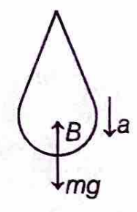
where, $B=$ buoyant force.
Here, we should assume that while removing some mass the volume of balloon and hence buoyant force will not change.
Let the new mass of the balloon is $m^{\prime}$, so
On solving Eqs. (i) and (ii), we get
$\begin{aligned}
& m g-m^{\prime} g=m a+m^{\prime} a \\
\Rightarrow \quad & m(g-a)=m^{\prime}(g+a) \Rightarrow m^{\prime}=\frac{m(g-a)}{g+a}
\end{aligned}$
So, mass removed, $\Delta m=m-m^{\prime}$
$=m\left[1-\frac{(g-a)}{(g+a)}\right]=m\left[\frac{g+a-g+a}{g+a}\right]=\frac{2 m a}{g+a}$
where, $B=$ buoyant force.
Here, we should assume that while removing some mass the volume of balloon and hence buoyant force will not change.
Let the new mass of the balloon is $m^{\prime}$, so
On solving Eqs. (i) and (ii), we get
$\begin{aligned}
& m g-m^{\prime} g=m a+m^{\prime} a \\
\Rightarrow \quad & m(g-a)=m^{\prime}(g+a) \Rightarrow m^{\prime}=\frac{m(g-a)}{g+a}
\end{aligned}$
So, mass removed, $\Delta m=m-m^{\prime}$
$=m\left[1-\frac{(g-a)}{(g+a)}\right]=m\left[\frac{g+a-g+a}{g+a}\right]=\frac{2 m a}{g+a}$
Looking for more such questions to practice?
Download the MARKS App - The ultimate prep app for IIT JEE & NEET with chapter-wise PYQs, revision notes, formula sheets, custom tests & much more.