Search any question & find its solution
Question:
Answered & Verified by Expert
A box of $1.00 \mathrm{~m}^3$ is filled with nitrogen at $1.50 \mathrm{~atm}$ at $300 \mathrm{~K}$. The box has a hole of an area $0.010 \mathrm{~mm}^2$. How much time is required for the pressure to reduce by $0.10 \mathrm{~atm}$, if the pressure outside is $1 \mathrm{~atm}$.
Solution:
1073 Upvotes
Verified Answer
As given that volume of the box, $V=1.00 \mathrm{~m}^3$ Area $(a)=0.010 \mathrm{~mm}^2=.01 \times 10^{-6} \mathrm{~m}^2$
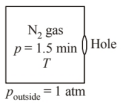
Temperature outside $=$ Temperature inside
Initial pressure inside the box $\left(p_1\right)=1.50 \mathrm{~atm}$.
For outside $\left(p_2\right)=1 \mathrm{~atm}$
Final pressure inside the box $\left(p_1^{\prime}\right)=0.10 \mathrm{~atm}$
So after time $T$ pressure reduced by $0.1$ and becomes $\left(p_2^{\prime}\right)$ $=1.5-0.1=1.4 \mathrm{~atm}$.
Assuming,
$v_{i x}=$ Speed of nitrogen molecule inside the box along $x$ direction.
$n_i=$ Number of molecules per unit volume in a time interval of $\Delta T$, all the particles at a distance $\left(v_{i x} \Delta t\right)$ will collide the hole and the wall, the particle colliding along the hole will escape out reducing the pressure in the box.
Let area of the wall, number of particles colliding in time $\Delta t$ on a wall of cube
$$
\Delta t=\frac{1}{2} \rho n_i\left(v_{i x} \Delta t\right) A
$$
$\frac{1}{2}$ is the factor because all the particles along $x$-direction are behaving randomly. Hence, half of these are colliding against the walls on either side.
Inside the box,
$$
v_{i x}^2+v_{i y}^2+v_{i z}^2=v_{\mathrm{rms}}^2 \quad\left(\mathrm{~N}_2 \text { molecule }\right)
$$
$v_{i x}^2=\frac{v_{\mathrm{m} \mathrm{m}}^2}{3}$
(i) $\quad\left(\because v_{i x}=v_{i y}=v_{i z}\right)$
K.E. of gas molecule $=\frac{3}{2} k_B T$
or $\frac{1}{2} m v_{\mathrm{rms}}^2=\frac{3}{2} k_B T$
$\left[v_{\text {rms }}=\right.$ Root mean square velocity,
$k_B=$ Boltzmann constant, $T=$ temperature $]$
$$
\begin{aligned}
&v_{\mathrm{rms}}^2=\frac{3 k_B T}{m} \\
&v_{\mathrm{rms}}=\sqrt{\frac{3 k_B T}{m}}
\end{aligned}
$$
From (i) equation,
Now, $v_{i x}^2=\frac{v_{\mathrm{mbs}}^2}{3}=\frac{1}{3} \times \frac{3 k_B T}{m}$
or $v_{i x}^2=\frac{k_B T}{m}$ or $v_{i x}=\sqrt{\frac{k_B T}{m}}$
$\therefore$ Number of $\mathrm{N}_2$ gas molecule striking to hole in $\Delta t$ time (outward)
$$
\Delta t=\frac{1}{2} \rho n_{\mathrm{l}} \sqrt{\frac{k_B T}{m}} \Delta t A
$$
The number of air molecule striking to hole in $\Delta t$ inward
$$
=\frac{1}{2} \rho n_2 \sqrt{\frac{k_B T}{m}}(\Delta t) a
$$
If particles collide along hole, they move out. Simiiarly, outer particles colliding along hole will move in. If $a=$ area of hole Then, net number of particle flow in $\Delta t$ time going outward,
$$
\begin{aligned}
\Delta t &=\frac{1}{2} \rho n_1 \sqrt{\frac{k_B T}{m}} \Delta t a-\frac{1}{2} \rho n_2 \sqrt{\frac{k_B T}{m}} \Delta t a \\
&=\frac{1}{2}\left(\rho n_1-\rho n_2\right) \sqrt{\frac{k_B T}{m}} \Delta t a
\end{aligned}
$$
[Temperature inside and outside the box are equal]
$$
\begin{aligned}
&p V=\mu R T \Rightarrow \mu=\frac{p V}{R T} \\
&\rho n_1=\frac{N \text { (total no. of molecule in box) }}{\text { Volume of box }}=\left(\frac{\mu N_A}{V}\right) \\
&\rho n_1=\frac{P_1 N_A}{R T} \quad \text { (per unit volume) } \\
&\text { and } \rho n_2=\frac{P_2^{\prime} N_A}{R T} \quad \text { (per unit volume) }
\end{aligned}
$$
Now, number of molecules gone out $=\rho n_1 V-\rho^{\prime} n_2 V$
$$
\begin{aligned}
&=\frac{1}{2}\left(\rho n_1-\rho^{\prime} n_2\right) \sqrt{\frac{k_B T}{m}} \tau a \\
&{\left[\therefore \rho n_1-\rho n_2=\frac{P_1 N_A}{R T}-\frac{P_2 N_A}{R T}=\frac{N_A}{R T}\left(\mathrm{P}_1-P_2\right)\right]} \\
&\quad=\frac{1}{2}\left(\mathrm{P}_1-P_2\right) \frac{N_A}{R T} \sqrt{\frac{k_B T}{m}} \tau a
\end{aligned}
$$
Equating equation (i) \& (ii),
$$
\frac{1}{2}\left(\rho_1-\rho_2\right) \frac{N_A}{R T} \sqrt{\frac{k_B T}{m}} \tau a=\frac{N_A V}{R T}\left(\rho_1-\rho_2^{\prime}\right)
$$
So, $\tau=2\left(\frac{P_1-P_2^{\prime}}{P_1-P_2}\right) \frac{V}{a} \sqrt{\frac{m}{k_B T}}$
Putting the values from the given values,
$$
\begin{aligned}
\tau &=2\left(\frac{1.5-1.4}{1.5-1.0}\right) \frac{1 \times 1.00}{0.01 \times 10^{-6}} \sqrt{\frac{46.7 \times 10^{-27}}{1.38 \times 10^{-23} \times 300}} \\
&=2\left(\frac{0.1}{0.5}\right) \frac{1}{10^{-8}} \sqrt{\frac{4.7}{1.38 \times 3} \times 10^{-6}} \\
&=2\left(\frac{1}{5}\right) 1 \times 10^8 \times 10^{-2} \times \sqrt{\frac{46.7}{4.14}} \\
&=\frac{2}{5} \times 10^5 \sqrt{\frac{45.7}{4.14}}=\frac{2}{5} \times 10^5 \sqrt{11.28} \\
&=\frac{2}{5} \times 3.358 \times 10^5=\frac{6.717}{5} \times 10^5 \\
&=1.34 \times 10^5 \text { seconds }
\end{aligned}
$$
Temperature outside $=$ Temperature inside
Initial pressure inside the box $\left(p_1\right)=1.50 \mathrm{~atm}$.
For outside $\left(p_2\right)=1 \mathrm{~atm}$
Final pressure inside the box $\left(p_1^{\prime}\right)=0.10 \mathrm{~atm}$
So after time $T$ pressure reduced by $0.1$ and becomes $\left(p_2^{\prime}\right)$ $=1.5-0.1=1.4 \mathrm{~atm}$.
Assuming,
$v_{i x}=$ Speed of nitrogen molecule inside the box along $x$ direction.
$n_i=$ Number of molecules per unit volume in a time interval of $\Delta T$, all the particles at a distance $\left(v_{i x} \Delta t\right)$ will collide the hole and the wall, the particle colliding along the hole will escape out reducing the pressure in the box.
Let area of the wall, number of particles colliding in time $\Delta t$ on a wall of cube
$$
\Delta t=\frac{1}{2} \rho n_i\left(v_{i x} \Delta t\right) A
$$
$\frac{1}{2}$ is the factor because all the particles along $x$-direction are behaving randomly. Hence, half of these are colliding against the walls on either side.
Inside the box,
$$
v_{i x}^2+v_{i y}^2+v_{i z}^2=v_{\mathrm{rms}}^2 \quad\left(\mathrm{~N}_2 \text { molecule }\right)
$$
$v_{i x}^2=\frac{v_{\mathrm{m} \mathrm{m}}^2}{3}$
(i) $\quad\left(\because v_{i x}=v_{i y}=v_{i z}\right)$
K.E. of gas molecule $=\frac{3}{2} k_B T$
or $\frac{1}{2} m v_{\mathrm{rms}}^2=\frac{3}{2} k_B T$
$\left[v_{\text {rms }}=\right.$ Root mean square velocity,
$k_B=$ Boltzmann constant, $T=$ temperature $]$
$$
\begin{aligned}
&v_{\mathrm{rms}}^2=\frac{3 k_B T}{m} \\
&v_{\mathrm{rms}}=\sqrt{\frac{3 k_B T}{m}}
\end{aligned}
$$
From (i) equation,
Now, $v_{i x}^2=\frac{v_{\mathrm{mbs}}^2}{3}=\frac{1}{3} \times \frac{3 k_B T}{m}$
or $v_{i x}^2=\frac{k_B T}{m}$ or $v_{i x}=\sqrt{\frac{k_B T}{m}}$
$\therefore$ Number of $\mathrm{N}_2$ gas molecule striking to hole in $\Delta t$ time (outward)
$$
\Delta t=\frac{1}{2} \rho n_{\mathrm{l}} \sqrt{\frac{k_B T}{m}} \Delta t A
$$
The number of air molecule striking to hole in $\Delta t$ inward
$$
=\frac{1}{2} \rho n_2 \sqrt{\frac{k_B T}{m}}(\Delta t) a
$$
If particles collide along hole, they move out. Simiiarly, outer particles colliding along hole will move in. If $a=$ area of hole Then, net number of particle flow in $\Delta t$ time going outward,
$$
\begin{aligned}
\Delta t &=\frac{1}{2} \rho n_1 \sqrt{\frac{k_B T}{m}} \Delta t a-\frac{1}{2} \rho n_2 \sqrt{\frac{k_B T}{m}} \Delta t a \\
&=\frac{1}{2}\left(\rho n_1-\rho n_2\right) \sqrt{\frac{k_B T}{m}} \Delta t a
\end{aligned}
$$
[Temperature inside and outside the box are equal]
$$
\begin{aligned}
&p V=\mu R T \Rightarrow \mu=\frac{p V}{R T} \\
&\rho n_1=\frac{N \text { (total no. of molecule in box) }}{\text { Volume of box }}=\left(\frac{\mu N_A}{V}\right) \\
&\rho n_1=\frac{P_1 N_A}{R T} \quad \text { (per unit volume) } \\
&\text { and } \rho n_2=\frac{P_2^{\prime} N_A}{R T} \quad \text { (per unit volume) }
\end{aligned}
$$
Now, number of molecules gone out $=\rho n_1 V-\rho^{\prime} n_2 V$
$$
\begin{aligned}
&=\frac{1}{2}\left(\rho n_1-\rho^{\prime} n_2\right) \sqrt{\frac{k_B T}{m}} \tau a \\
&{\left[\therefore \rho n_1-\rho n_2=\frac{P_1 N_A}{R T}-\frac{P_2 N_A}{R T}=\frac{N_A}{R T}\left(\mathrm{P}_1-P_2\right)\right]} \\
&\quad=\frac{1}{2}\left(\mathrm{P}_1-P_2\right) \frac{N_A}{R T} \sqrt{\frac{k_B T}{m}} \tau a
\end{aligned}
$$
Equating equation (i) \& (ii),
$$
\frac{1}{2}\left(\rho_1-\rho_2\right) \frac{N_A}{R T} \sqrt{\frac{k_B T}{m}} \tau a=\frac{N_A V}{R T}\left(\rho_1-\rho_2^{\prime}\right)
$$
So, $\tau=2\left(\frac{P_1-P_2^{\prime}}{P_1-P_2}\right) \frac{V}{a} \sqrt{\frac{m}{k_B T}}$
Putting the values from the given values,
$$
\begin{aligned}
\tau &=2\left(\frac{1.5-1.4}{1.5-1.0}\right) \frac{1 \times 1.00}{0.01 \times 10^{-6}} \sqrt{\frac{46.7 \times 10^{-27}}{1.38 \times 10^{-23} \times 300}} \\
&=2\left(\frac{0.1}{0.5}\right) \frac{1}{10^{-8}} \sqrt{\frac{4.7}{1.38 \times 3} \times 10^{-6}} \\
&=2\left(\frac{1}{5}\right) 1 \times 10^8 \times 10^{-2} \times \sqrt{\frac{46.7}{4.14}} \\
&=\frac{2}{5} \times 10^5 \sqrt{\frac{45.7}{4.14}}=\frac{2}{5} \times 10^5 \sqrt{11.28} \\
&=\frac{2}{5} \times 3.358 \times 10^5=\frac{6.717}{5} \times 10^5 \\
&=1.34 \times 10^5 \text { seconds }
\end{aligned}
$$
Looking for more such questions to practice?
Download the MARKS App - The ultimate prep app for IIT JEE & NEET with chapter-wise PYQs, revision notes, formula sheets, custom tests & much more.