Search any question & find its solution
Question:
Answered & Verified by Expert
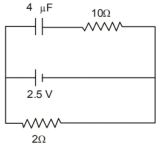
A capacitor of $4 \mu \mathrm{F}$ is connected as shown in the circuit. The internal resistance of the battery is $0.5 \Omega$. The amount of charge on the capacitor plates will be
Options:
Solution:
1284 Upvotes
Verified Answer
The correct answer is:
$8 \mu \mathrm{C}$
$8 \mu \mathrm{C}$
As capacitor offers infinite resistance in dc-circuit. So, current flows through $2 \Omega$ resistance from left to right, given by
$$
\mathrm{I}=\frac{\mathrm{V}}{\mathrm{R}+\mathrm{r}}=\frac{2.5 \mathrm{~V}}{2+0.5}=\frac{2.5}{2.5}=1 \mathrm{~A}
$$
So, the potential difference across $2 \Omega$ resistance $\mathrm{V}=\mathrm{IR}=1 \times 2=2$ volt.
Since, capacitor is in parallel with $2 \Omega$ resistance, so it also has $2 \mathrm{~V}$ potential difference across it.
As current does not flow through capacitor branch so no potential drop will be accross $10 \Omega$ resistance.The charge on capacitor
$$
\mathrm{q}=\mathrm{CV}=(4 \mu \mathrm{F}) \times 2 \mathrm{~V}=8 \mu \mathrm{C}
$$
$$
\mathrm{I}=\frac{\mathrm{V}}{\mathrm{R}+\mathrm{r}}=\frac{2.5 \mathrm{~V}}{2+0.5}=\frac{2.5}{2.5}=1 \mathrm{~A}
$$
So, the potential difference across $2 \Omega$ resistance $\mathrm{V}=\mathrm{IR}=1 \times 2=2$ volt.
Since, capacitor is in parallel with $2 \Omega$ resistance, so it also has $2 \mathrm{~V}$ potential difference across it.
As current does not flow through capacitor branch so no potential drop will be accross $10 \Omega$ resistance.The charge on capacitor
$$
\mathrm{q}=\mathrm{CV}=(4 \mu \mathrm{F}) \times 2 \mathrm{~V}=8 \mu \mathrm{C}
$$
Looking for more such questions to practice?
Download the MARKS App - The ultimate prep app for IIT JEE & NEET with chapter-wise PYQs, revision notes, formula sheets, custom tests & much more.