Search any question & find its solution
Question:
Answered & Verified by Expert
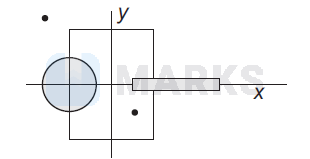
A disk of radius $\frac{a}{4}$ having a uniformly distributed charge $6 \mathrm{C}$ is placed in the $x-y$ plane with its centre at $\left(\frac{-a}{2}, 0,0\right)$. A rod of length a carrying a uniformly distributed charge $8 \mathrm{C}$ is placed on the $x$-axis from $x=\frac{a}{4}$ to $x=\frac{5 a}{4}$. Two point charges $-7 \mathrm{C}$ and $3 \mathrm{C}$ are placed at $\left(\frac{a}{4}, \frac{-a}{4}, 0\right)$ and $\left(\frac{-3 a}{4}, \frac{3 a}{4}, 0\right)$, respectively. Consider a cubical surface formed by six surfaces $x=\pm \frac{a}{2}, y=\pm \frac{a}{2}, z=\pm \frac{a}{2}$.
The electric flux through this cubical surface is
Options:
The electric flux through this cubical surface is
Solution:
2460 Upvotes
Verified Answer
The correct answer is:
$\frac{-2 C}{\varepsilon_0}$
$\frac{-2 C}{\varepsilon_0}$
Total enclosed charge as already shown is
$$
q_{\text {net }}=\frac{6 C}{2}+\frac{8 C}{4}-7 C=-2 C
$$
From Gauss-theorem, net flux,
$$
\varphi_{\text {net }}=\frac{q_{\text {net }}}{\varepsilon_0}=\frac{-2 C}{\varepsilon_0}
$$
$$
q_{\text {net }}=\frac{6 C}{2}+\frac{8 C}{4}-7 C=-2 C
$$
From Gauss-theorem, net flux,
$$
\varphi_{\text {net }}=\frac{q_{\text {net }}}{\varepsilon_0}=\frac{-2 C}{\varepsilon_0}
$$
Looking for more such questions to practice?
Download the MARKS App - The ultimate prep app for IIT JEE & NEET with chapter-wise PYQs, revision notes, formula sheets, custom tests & much more.