Search any question & find its solution
Question:
Answered & Verified by Expert
A long horizontal rod has a bead which can slide along its length and is initially placed at a distance \( L \) from one end \( A \) of the rod. The rod is set in angular motion about \( A \) with a constant angular acceleration \( a \). If the coefficient of friction between the rod and bead is \( \mu \), and gravity is neglected, then the time after which the bead starts slipping is
Options:
Solution:
2387 Upvotes
Verified Answer
The correct answer is:
\( \sqrt{\frac{\mu}{\alpha}} \)
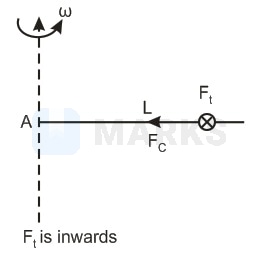
Tangential force $\left(F_{t}\right)$ of the bead will be given by the normal reaction $(\mathrm{N})$, while centripetal force $\left(F_{c}\right)$ is provided by friction $\left(f_{r}\right)$ The bead starts sliding when the centripetal force is just equal to the limiting friction,
Therefore,
$F_{t}=m a=m \alpha L=N$
Therefore, limiting value of friction
Angular velocity at time $t$ is $\omega=\alpha t(f r)_{\max }=\mu N=\mu m \alpha L \quad \ldots$ (i)
Centripetal force at time $t$ will be $F e=m L \omega 2=m L \alpha 2 t 2 \ldots(i i)$
Equating equations $(i)$ and $(i i)$, we get,
$t=\sqrt{\frac{\mu}{\alpha}}$
For $t>F_{c}>(f r)_{\max }$,
i. e., the bead starts sliding.
In the figure, $F_{t}$ is perpendicular to the paper inwards.
Therefore,
$F_{t}=m a=m \alpha L=N$
Therefore, limiting value of friction
Angular velocity at time $t$ is $\omega=\alpha t(f r)_{\max }=\mu N=\mu m \alpha L \quad \ldots$ (i)
Centripetal force at time $t$ will be $F e=m L \omega 2=m L \alpha 2 t 2 \ldots(i i)$
Equating equations $(i)$ and $(i i)$, we get,
$t=\sqrt{\frac{\mu}{\alpha}}$
For $t>F_{c}>(f r)_{\max }$,
i. e., the bead starts sliding.
In the figure, $F_{t}$ is perpendicular to the paper inwards.
Looking for more such questions to practice?
Download the MARKS App - The ultimate prep app for IIT JEE & NEET with chapter-wise PYQs, revision notes, formula sheets, custom tests & much more.