Search any question & find its solution
Question:
Answered & Verified by Expert
A parallel plate capacitor of capacitance $\mathrm{C}$ is connected to a battery and is charged to a potential difference $\mathrm{V}$. Another capacitor of capacitance $2 \mathrm{C}$ is similarly charge to a potential difference $2 \mathrm{~V}$. The charging battery is now disconnected and the capacitors are connected in parallel to each other in such a way that the positive terminal of one is connected to the negative terminal of the other. The final energy of the configuration is
Options:
Solution:
2723 Upvotes
Verified Answer
The correct answer is:
$\frac{3}{2} \mathrm{CV}^{2}$
From the figure. The net charge shared between the capacitors
$$
Q^{\prime}=Q_{2}-Q_{2}=4 C V-C V=3 C V
$$
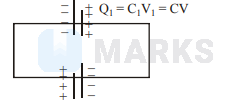
The two capacitors will have some potential, say $\mathrm{V}^{\prime}$. The net capacitance of the parallel combination of the two capacitors
$$
C^{\prime}=C_{1}+C_{2}=C+2 C+3 C
$$
The potential of the capacitors
$$
\mathrm{V}^{\prime}=\frac{\mathrm{Q}^{\prime}}{\mathrm{C}^{\prime}}=\frac{3 \mathrm{CV}}{3 \mathrm{C}}=\mathrm{V}
$$
The electrostatic energy of the capacitors
$$
\mathrm{E}^{\prime}=\frac{1}{2} \mathrm{C}^{\prime} \mathrm{V}^{\prime 2}=\frac{1}{2}(3 \mathrm{C}) \mathrm{V}^{2}=\frac{3}{2} \mathrm{CV}^{2}
$$
$$
Q^{\prime}=Q_{2}-Q_{2}=4 C V-C V=3 C V
$$
The two capacitors will have some potential, say $\mathrm{V}^{\prime}$. The net capacitance of the parallel combination of the two capacitors
$$
C^{\prime}=C_{1}+C_{2}=C+2 C+3 C
$$
The potential of the capacitors
$$
\mathrm{V}^{\prime}=\frac{\mathrm{Q}^{\prime}}{\mathrm{C}^{\prime}}=\frac{3 \mathrm{CV}}{3 \mathrm{C}}=\mathrm{V}
$$
The electrostatic energy of the capacitors
$$
\mathrm{E}^{\prime}=\frac{1}{2} \mathrm{C}^{\prime} \mathrm{V}^{\prime 2}=\frac{1}{2}(3 \mathrm{C}) \mathrm{V}^{2}=\frac{3}{2} \mathrm{CV}^{2}
$$
Looking for more such questions to practice?
Download the MARKS App - The ultimate prep app for IIT JEE & NEET with chapter-wise PYQs, revision notes, formula sheets, custom tests & much more.